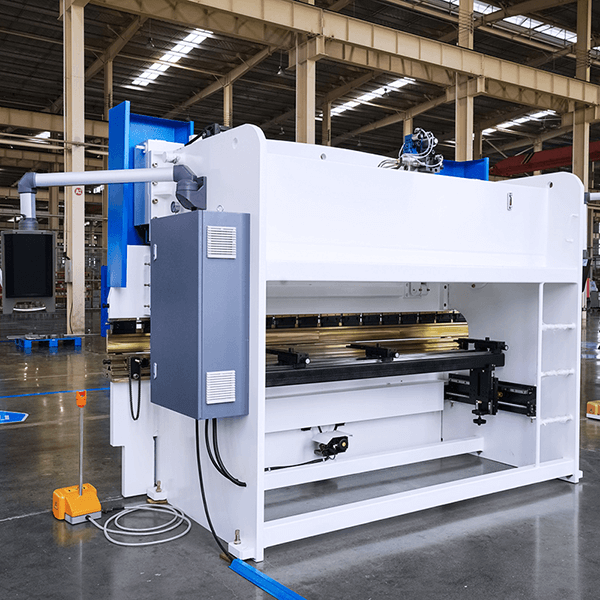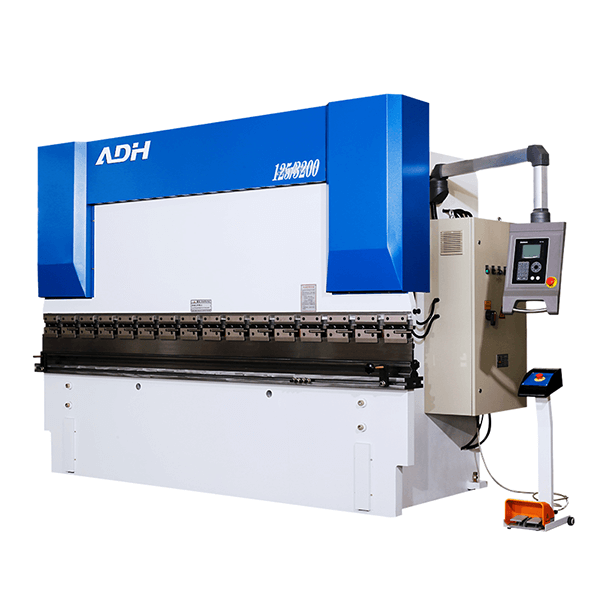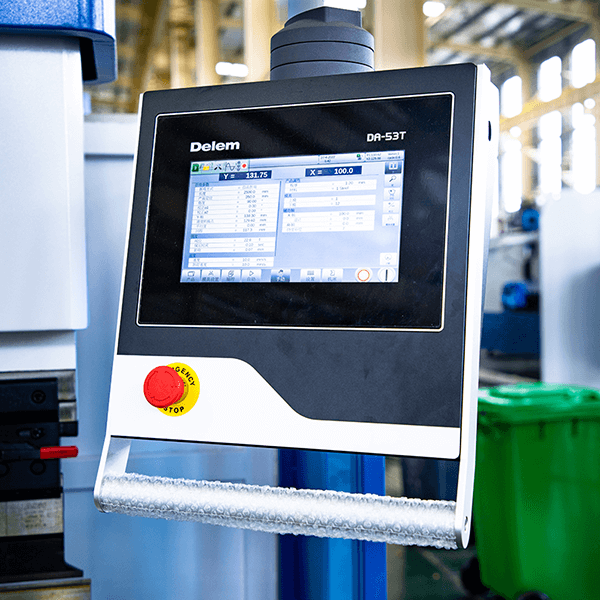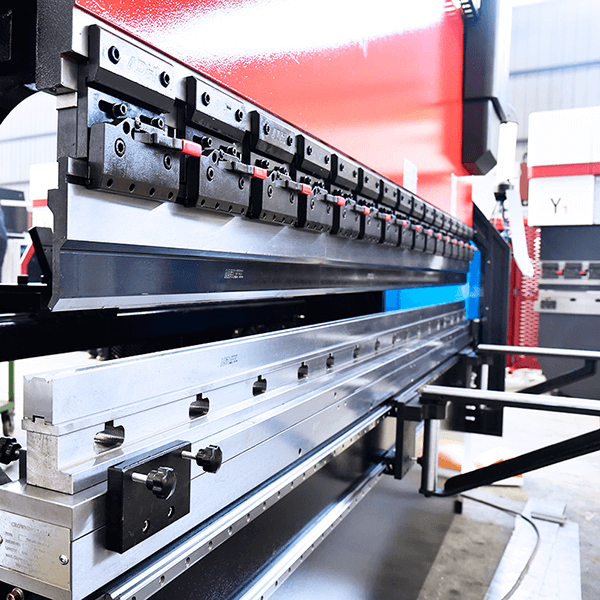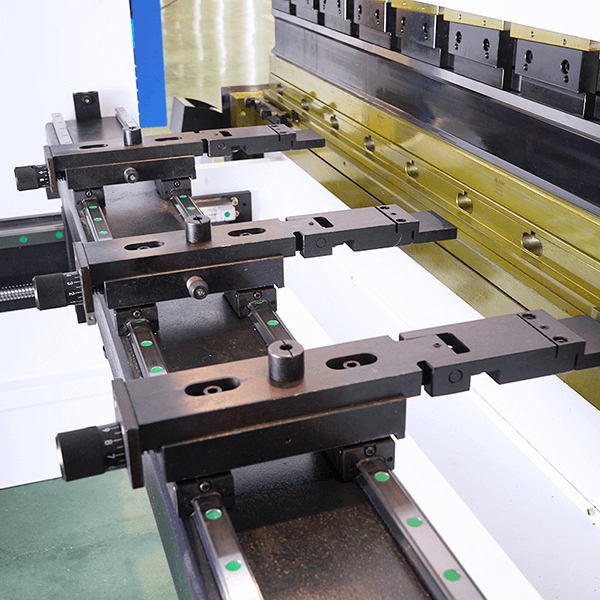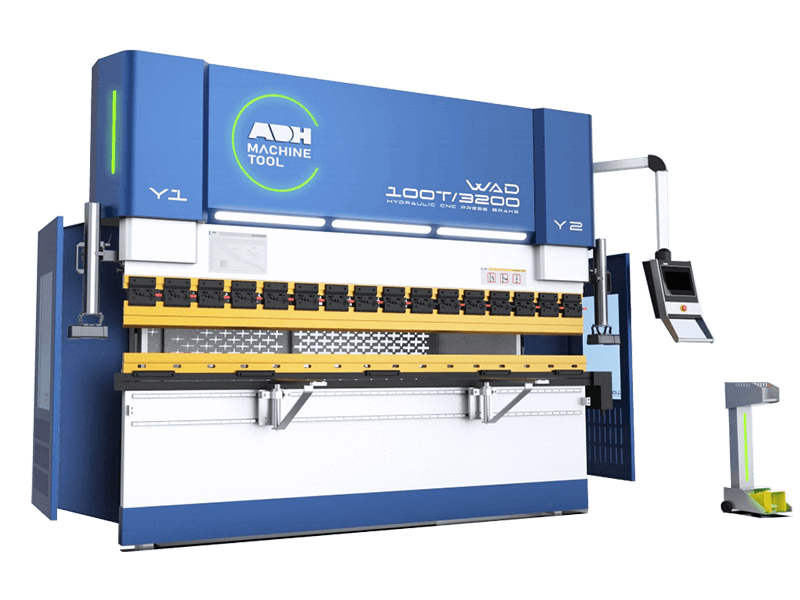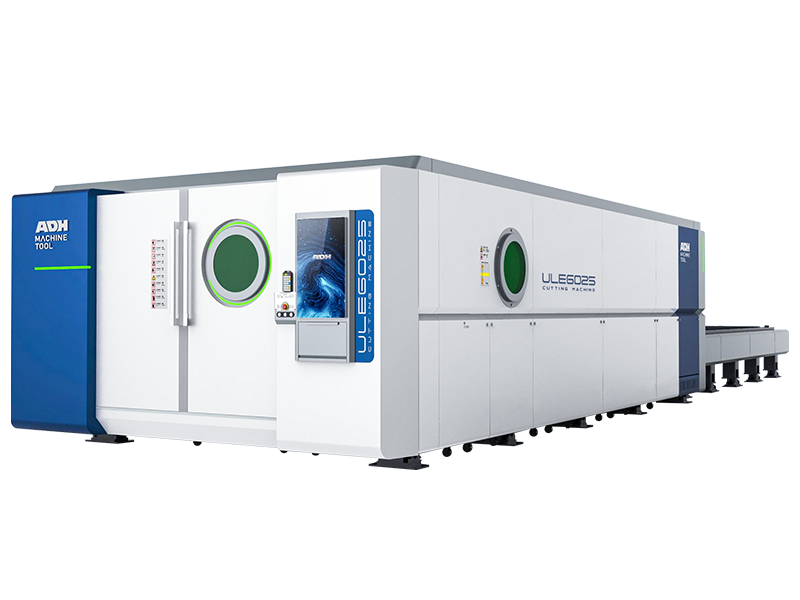
A press brake is a powerful machine tool used in metalworking to bend and shape metal sheets with precision. It operates by clamping the workpiece between a punch and die, applying force to achieve the desired bend angle or shape.
They are widely used in industries like automotive, aerospace, and construction due to their ability to meet exact specifications. As the demand for precision, efficiency, and productivity in manufacturing continues to grow, press brake technology has undergone significant advancements.
From the early days of manual operation to Numerical Control (NC) systems and now Computer Numerical Control (CNC) systems, the functionality and performance of press brakes have greatly improved.
In today’s market, NC press brake vs CNC press brake play vital roles. An NC press brake or CNC press brake is a type of press brake machine that uses a CNC system (a numerical control system) to control the bending process.
1.1 Beyond Definitions: Seeing the Fundamental Differences Between NC and CNC at a Glance
To make a truly informed decision, we must cut through the jargon and reach the core of NC and CNC. These are not merely abbreviations—they embody two completely different philosophies of production.
NC (Numerical Control): The Faithful Executor of Fixed Commands Imagine an extremely loyal soldier who carries out orders without question—that’s the NC press brake. Every motion, from the ram’s downward stroke to the backgauge position, follows a set of rigid, predefined electronic instructions. The operator inputs and oversees these commands, and the machine executes them with unwavering precision. However, it lacks the ability to perceive changes in its environment—such as material springback or oil temperature variations—and cannot self-correct during operation. Its world is linear and deterministic, excelling only at repetitive tasks under ideal conditions.
CNC (Computer Numerical Control): The Intelligent, Real-Time Partner In contrast, a CNC press brake operates like a collaborator equipped with both a “brain” and a “nervous system.” Its core is a powerful industrial computer capable of interpreting complex CAD drawings and 3D models, while performing massive computations within microseconds. More importantly, through its closed-loop control system composed of sensors such as linear scales and servo valves, it continuously monitors the ram’s position in real time and compares it to theoretical values. The moment any deviation is detected, the system instantly compensates. This gives CNC machines the extraordinary ability to maintain micron-level accuracy even amid real-world variables and dynamic conditions.
Quick Reference: Core Differences Overview
This table provides a 30-second snapshot of the essential differences between NC and CNC press brakes:
Dimension
NC (Numerical Control) Press Brake
CNC (Computer Numerical Control) Press Brake
Control Core
Simple logic circuits or single-board controllers executing fixed programs.
High-performance industrial computer capable of real-time complex computation and closed-loop control.
Programming Method
Relies on manual input of angles and depths; cumbersome and prone to error.
Intuitive graphical interface supporting offline programming and automatic program generation from 3D models.
Feedback Mechanism
Open-loop control with no real-time error monitoring or automatic correction.
Closed-loop control with real-time feedback from sensors like linear scales for automatic compensation.
Automation Level
Low; multiple axes must be adjusted manually, and tool changes are time-consuming.
High; multi-axis coordination (Y1/Y2, X, R, Z, etc.) enables fast tool changes and automated adjustment.
Accuracy Limit
Repetitive positioning depends on mechanical setup and operator skill; consistency varies.
1.2 Why This Comparison Matters: Unlocking the Code to Enhanced Productivity
Understanding these distinctions is essential because they directly impact the core concerns that keep factory managers up at night—cost, efficiency, precision, and long-term sustainability.
Confronting the Cost Dilemma: Are you burdened by high scrap rates or over-reliance on veteran operators? NC’s limited precision leads to greater material waste and rework. By contrast, CNC’s exceptional accuracy minimizes scrap and reduces dependency on operator intuition, transforming hidden “experience costs” into measurable “technology dividends.”
Breaking the Efficiency Barrier: Are delivery deadlines slipping due to long setup times? In a market dominated by small batch, multi-variety orders, NC’s prolonged preparation becomes a serious bottleneck. CNC’s offline programming, fast tool changes, and automatic positioning drastically reduce non-productive time, enabling your production line to respond to market shifts with remarkable speed.
Crossing the Precision Threshold: Dreaming of entering high-value sectors such as aerospace, medical devices, or precision electronics? NC’s accuracy ceiling confines it to standard applications. CNC’s micron-level repeatability, however, serves as a passport to these demanding markets where tight tolerances translate directly into higher profit margins.
Embracing Business Flexibility: Have you ever turned down complex, high-margin orders due to process limitations? NC’s rigid functionality restricts innovation in your offerings. CNC’s powerful multi-axis capabilities easily handle conical bends, hemming operations, and multi-angle combinations—making it not merely a machine, but your gateway to new markets and profit opportunities.
Thus, this comprehensive analysis is far more than a technical brief—it’s a strategic decision-making guide tailored specifically for you. In the coming sections, we’ll delve into each technical aspect, decode its financial implications, and provide a clear, actionable framework to help you navigate the complexity and choose the press brake that truly drives your enterprise’s future growth.
II. Introduction to NC Press Brakes
2.1 What Is an NC Press Brake?
An NC (Numerical Control) press brake is a type of machine tool used in metal forming to bend sheet metal and other materials into precise shapes. Numerical control refers to a system that operates through pre-programmed numerical data, allowing the machine's movements to be controlled automatically rather than entirely manually.
Unlike CNC (Computer Numerical Control) systems, NC machines operate on a relatively simpler form of programming, often involving a sequence of manual inputs or punch tapes, which guide the bending process. On an NC press brake, the torsion bar forces cylinders on both sides to move up and down synchronously.
NC press brakes use motors or hydraulic systems to position components like the back gauge and ram, based on numerical commands. This provides automation, enhancing efficiency and repeatability, though operator monitoring and adjustments are still needed.
2.2 Key Features and Components of NC Press Brakes
Numerical Control System: Uses numerical codes for automated control of functions like back gauge movement and stroke depth.
Hydraulic or Mechanical Actuation: Primarily uses hydraulic systems for precise control; older models may use mechanical systems.
Basic Programmable Functions: Operators input angles or dimensions for bending processes; less automation than CNC systems.
Back Gauge Assembly: Ensures precise workpiece positioning with motorized numerical adjustments.
Manual Adjustments: Operators manually adjust settings like clamping forces and material alignment.
2.3 Advantages and Disadvantages of NC Press Brake
The NC press brake is controlled by an NC system to control the up-and-down movement of the punch and bend the metal sheet. It has several advantages over manual press brakes, including improved consistency in bending speed and accuracy, and reduced reliance on skilled operators.
In comparison to manual press brakes, NC press brakes significantly increase bending speed and precision. The NC system is used to control various aspects of the bending process, such as stroke speed and the number of bends.
This allows for repeated bending to be performed consistently, with a focus on both speed and precision. The NC press brake can enhance the production efficiency of parts and ensure the quality of the final products.
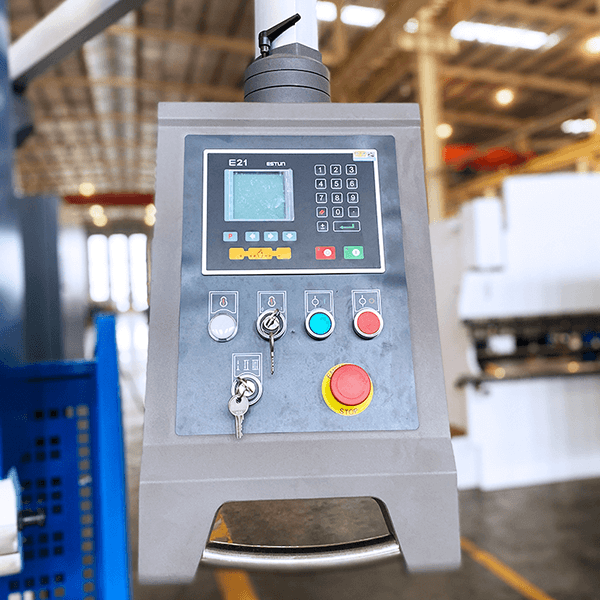
Furthermore, the NC bending machine reduces the skill requirements for operators compared to manual press brakes. Manual press brakes require the operator to set up the machine and adjust the die manually, whereas, with NC press brakes, most bending programs can be completed by programming a controller such as the E21 Press Brake Controller or by setting parameters.
The operator's role is mostly limited to loading and unloading sheet metal. Once the NC system is programmed, the NC press brake can also perform automatic bending, following the set procedures and steps to improve production efficiency.
While the NC press brake has higher initial costs for machine purchase and personnel training, it is not as efficient as a skilled operator in handling emergencies or complex bending.
It is important to note that although the NC press brake has greater automation capabilities, it still requires a certain level of skill and knowledge to operate effectively.
III. Introduction to CNC Press Brakes
3.1 What Is a CNC Press Brake?
A CNC (Computer Numerical Control) press brake is a machine tool used in the metalworking industry to bend sheet metal and other materials with precision and automation. It integrates computerized control systems for programming and real-time monitoring, allowing operators to create complex bending sequences and optimize production workflows through software interfaces.
CNC press brakes use digital commands for precise bending, controlling ram position, back gauge, and force. Powered by hydraulic or electric systems, they enhance precision and efficiency. Advanced systems minimize operator intervention and errors, essential in modern sheet metal fabrication.
3.2 High-Level Automation and Programming Features
Multi-Axis Control: Up to 12 controlled axes for precise manipulation of components, enabling intricate bends and complex geometries.
Programmable Ram Motion and Force: Pre-defined bending sequences and adjustments ensure consistent quality for varying materials.
Graphical User Interfaces (GUI): Touchscreens and intuitive software allow visualization of bending simulations, highlighting potential errors.
Offline Programming: CNC software enables external program creation and direct machine upload, reducing downtime.
3.3 Advantages and Disadvantages of CNC Press Brake
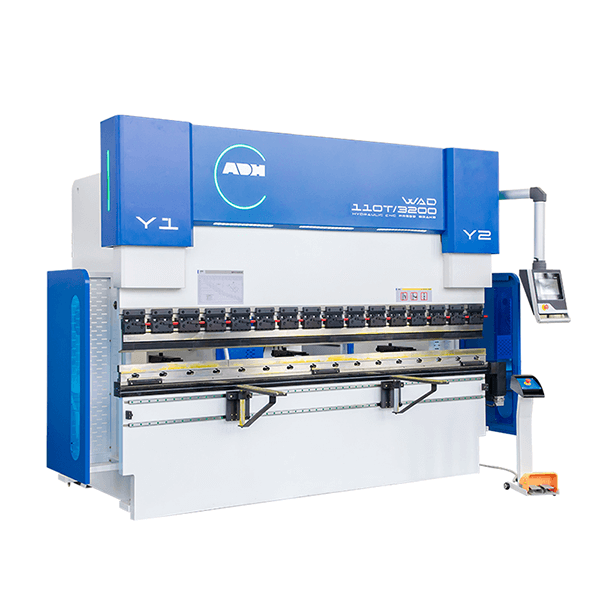
The CNC press brake, or computer numerical control press brake, is used for bending metal sheets. Compared to the NC press brake, the CNC press brake has a more advanced CNC system that results in higher bending speed, precision, and automation.
The CNC press brake's more advanced controller allows for more accurate bending, with the ability to achieve precise bending speed and angle and a final accurate workpiece. This improved accuracy and quality of the workpiece helps reduce production costs.
The CNC press brake can also produce workpieces with more complex shapes, thanks to its advanced CNC controller that can be programmed through complex algorithms.
This allows for greater control of the bending accuracy of the die, which is useful when processing workpieces with complex shapes and bending angles.
The CNC press brakes provide higher degrees of automation than the NC press brake. With the ability to program complex workpieces, the CNC press brake can bend according to the pre-determined program.
A more advanced version of the CNC press brake is a bending center equipped with a robotic arm. The CNC press brake is ideal for complex bending, increasing output and efficiency.
However, the CNC hydraulic press brake also has a higher cost, with higher purchase and training expenses compared to NC press brakes. The operation of a CNC press brake is more complex, requiring higher skills from the operators.
CNC press brakes are used for complex workpiece bending or factories with high-volume production requirements. Due to its high accuracy, the processed workpiece often requires minimal rewo
Ⅳ. The Ultimate Showdown Across 8 Key Dimensions: Quantifying Differences to Eliminate Ambiguity
If the opening section offered a strategic overview, now we move into the tactical core—an in-depth, data-driven comparison between NC and CNC press brakes. Through precise metrics, vivid examples, and deep insights, we’ll transform vague generalities into measurable, tangible indicators of performance. These eight dimensions will become the foundation for your clear understanding and rational decision-making.
4.1 Control System and Programming: A Battle of Brains
At the heart of this comparison lies a generational leap in intelligence. The control systems of NC and CNC press brakes represent two fundamentally different levels of smart capability.
NC: The Mechanical Repeater of Commands The NC press brake’s “brain” consists of simple hardware logic circuits or microcontrollers. Its behavior mirrors that of an obedient executor rather than a thinker. Memory capacity is severely limited, forcing operators to input complex workpieces in separate segments—a process that’s cumbersome and error-prone. Most critically, it operates as an open-loop system, oblivious to any variables in the bending process. It cannot detect structural deformation under load (such as throat deflection), nor can it compensate for it, making inconsistent angles along the workpiece—different at the center and edges—a frequent occurrence.
CNC: An Intelligent Core with Learning and Adaptive Capability The brain of a CNC press brake is a powerful industrial computer equipped with vast memory, advanced graphics processing, and ultra-high-speed computation. It can directly import workpiece drawings (such as DXF or STEP files) into a 2D/3D graphical interface, automatically calculate flat patterns, recommend suitable tooling, plan optimal bending sequences, and perform real-time collision simulations. In practice, this means you can complete 99% of your trial-and-error digitally rather than wasting costly sheet material. More importantly, it integrates multiple sensors connected to a hydraulic crowning compensation system, precisely offsetting any deflection in the ram or table to ensure perfectly uniform angles across the entire length of the workpiece.
Unique Insight 1: The Generational Shift in Programming Logic NC programming follows a “process-oriented” mindset. The operator must think like the machine—manually calculating each step’s backgauge position (X-axis) and ram bottom dead center (Y-axis), while estimating material springback based purely on experience. The entire process is linear and instruction-driven, with the operator’s skill serving as the sole guarantor of quality.
In contrast, CNC programming follows a “goal-oriented” logic. The programmer simply defines the desired final geometry of the part, and the advanced software and controller determine the most efficient way to achieve it. This shift frees human intelligence from repetitive manual calculations, allowing operators to focus on high-value tasks such as process optimization and quality improvement. This autonomy forms the underlying reason why CNC systems can achieve complex bends successfully on the first attempt.
4.2 Automation and Multi-Axis Coordination: From “Single-Point Operation” to “Spatial Collaboration”
The number of controllable axes and the degree of coordinated motion directly determine a press brake’s capability for handling complex processes and achieving advanced levels of automation.
NC: Basic Two-Axis Movement A conventional NC press brake typically offers only 2 axes—the Y-axis controlling the ram’s vertical movement, and the X-axis managing the backgauge’s forward and backward movement. Adjustments along other planes, such as vertical or lateral repositioning of the backgauge, must be done manually—time-consuming, laborious, and inherently less precise.
CNC: Multi-Dimensional Coordination A CNC press brake, on the other hand, seamlessly synchronizes multiple axes—working like a finely tuned robotic team performing intricate maneuvers in perfect harmony.
Y1/Y2 Axes: Independently control the hydraulic cylinders on both sides of the ram, ensuring perfect parallelism with the worktable under any load—an essential principle of high-precision bending.
X Axis: Provides high-speed, high-precision forward and backward motion for the backgauge.
R Axis: Moves the backgauge vertically to accommodate different die heights or to clear pre-bent flanges.
Z1/Z2 Axes: Allow the left and right backgauge fingers to move independently—ideal for handling asymmetrical or tapered parts.
Additional Advanced Axes: Systems such as X1/X2, R1/R2, and automatic sheet followers further extend functionality, forming highly sophisticated automated bending cells.
Value Insight: The Process Liberation of Multi-Axis Coordination Imagine bending a conical funnel—a task nearly impossible on an NC machine. On a CNC press brake, however, the operator simply inputs the dimensions at both ends. The Z1 and Z2 axes automatically position themselves to form a precise slanted backgauge line, achieving a flawless cone in a single bend. Similarly, during hemming operations, the R-axis automatically rises or lowers to align with the flattening die. Techniques that once required specialized tooling and master-level craftsmanship are now executed effortlessly by multi-axis CNC systems.
4.3 Accuracy and Consistency: Breaking Free from the “Master Craftsman” Dependency
Accuracy distinguishes a tool that “works” from one that excels; consistency defines the true level of industrial production maturity.
NC: Craftsmanship-Level Accuracy Dependent on Experience In NC systems, precision is inconsistent and variable. It relies heavily on the operator’s tactile sense and experience—listening to sounds, watching sparks, and performing trial bends to compensate for variations in material thickness, hardness, or machine wear. In mass production, a conforming first piece doesn’t guarantee the hundredth will match; rising hydraulic temperature or differences among sheet batches can easily cause angle drift.
CNC: Micron-Level Precision Supported by Science CNC systems transform precision from an “art” into a “science” through closed-loop control. The key technology is the linear scale, mounted independently on both sides of the frame. Acting like an ultra-precise caliper, it continuously measures the exact distance between the ram and the table, sending feedback thousands of times per second to the CNC controller. Any deviation from the target triggers immediate servo-valve compensation, ensuring final ram positioning remains unaffected by oil temperature, load, or frame deflection.
Data Benchmark: Typical Tolerance Comparison Across the Industry * NC Press Brake: In batch production, angle consistency typically varies within ±1°, with backgauge repeatability around ±0.1 mm. * CNC Press Brake: Easily achieves angle consistency of ±0.5°, or better. Y-axis repeatability is usually better than ±0.01 mm, and in high-end models, reaches ±0.005 mm—several times finer than a human hair.
4.4 Production Efficiency and Speed: The Race for Output per Unit Time
In manufacturing, time is money. Efficiency competition ultimately depends on minimizing every form of non-productive time.
NC: Long Setup and Idle Periods The main bottleneck for NC machines lies in extensive setup time—tool changes, backgauge adjustments, and repeated trial bends to determine the correct bottom dead point can consume anywhere from 30 minutes to several hours. Moreover, ram speed is typically fixed and deliberately kept conservative to maintain safety and precision.
CNC: Every Second Counts Toward Production CNC machines integrate intelligent features that compress idle time to the absolute minimum.
Quick-Change Tooling System: Hydraulic or pneumatic clamping replaces manual screw fastening, allowing all dies to be locked or released at the touch of a button—reducing changeover time by more than 80%.
Automatic Positioning: When a new program or bending step is called, all relevant axes (X, R, Z, and crowning) automatically reposition within seconds to their preset locations.
Smart Speed Control: The controller optimizes ram travel—descending at maximum speed during idle motion, switching to precise forming speed just before contacting the material, and returning at full speed after the bend.
Efficiency Conversion: Profit Transformation Analysis Assume each workpiece requires five bending steps, with a daily production of 200 pieces.
NC Machine:
Initial setup + trial bending: 45 minutes
Cycle time per piece (including manual adjustment): 30 seconds/step × 5 steps = 150 seconds/piece
Offline programming (no machine downtime) + quick mold change and program call: 10 minutes
Cycle time per piece (fully automated): 12 seconds/step × 5 steps = 60 seconds/piece
Total time: 10 minutes + (60 seconds × 200 pieces) / 60 = 210 minutes = 3.5 hours In this case, the CNC machine takes less than 40% of the NC machine’s processing time. The 5.5 hours saved daily can be devoted to producing additional orders, effectively doubling daily profit potential.
4.5 Operational Threshold and Personnel Requirements: Shifting Skill Demands
This is an area fraught with misconceptions. Many believe CNC technology is more complex and harder to master—but in reality, the opposite is true.
NC Operators: Getting started may seem simple, but true mastery is exceptionally difficult. A skilled NC operator is an invaluable asset, carrying in his mind a vast collection of non-standard process know-how. Should he leave, production of certain complex parts could grind to a halt—an enormous hidden risk for the company.
CNC Operators: They need only basic blueprint reading and computer operation skills. For shop-floor workers, the process is remarkably streamlined: scan the work order → load the program → follow on-screen 3D prompts to mount the designated tooling → insert the sheet → press the foot pedal → retrieve 100% qualified parts.
Myth Busting: Debunking the “CNC Is Harder to Learn” Misconception The notion that “CNC is harder to learn” confuses operation with process programming. CNC technology drastically reduces dependency on operator skill, standardizing production so that even novices can quickly produce qualified parts. The true challenge shifts upstream—to process programming. This transformation is both positive and strategic, signaling that an enterprise’s core competence no longer resides in an irreplaceable “master craftsman,” but in a replicable, inheritable, and optimizable digital process asset. This dramatically enhances production stability and the team's resilience against risk.
4.6 Maintenance and Reliability: The Hidden Costs of Long-Term Ownership
The real value of equipment lies not only in how much it produces—but also in how much it consumes, especially the downtime lost to failures.
NC: Dispersed Failure Points and Lengthy Troubleshooting NC press brakes rely on mechanically synchronized structures such as torsion shafts, which experience multiple wear points. Over time, precision declines and calibration becomes difficult. Aging relays and contactors are distributed across many circuits, creating numerous potential fault points. Once a failure occurs, repairs can feel like searching for a needle in a haystack, heavily dependent on an experienced electrician. Downtime is often measured in days.
CNC: Modular Design and Intelligent Self-Diagnostics CNC press brakes feature modern modular architecture—servo drives, controllers, and I/O modules are independent, quick-swap units. More importantly, they include powerful self-diagnostic capabilities: the system continuously monitors component health, instantly displaying clear alarms (such as “Y1 Axis Encoder Signal Error”) and detailed troubleshooting guidance. This reduces fault localization from hours to minutes, significantly improving overall equipment effectiveness (OEE).
Practical Tool: “NC vs CNC Daily Maintenance Core Checklist”
Inspection Item
NC Press Brake (Weekly)
CNC Press Brake (System Prompt/Monthly)
Key Difference
Positioning Accuracy
Check backgauge and ram dead stops with measuring tools; manual adjustment
Run calibration program in system to verify encoder readings
Manual calibration vs automatic verification
Hydraulic System
Inspect oil level and temperature, listen for pump or valve noise
Review sensor alerts for oil level and filter pressure
Passive observation vs proactive warning
Synchronization System
Check torsion shaft or linkage connections for looseness
In diagnostics, review Y1/Y2 follow-error data
Physical wear inspection vs digital deviation check
Electrical Circuit
Inspect contactors and relay contacts for burns
Review CNC diagnostic log for intermittent alarms
Reactive repair vs predictive maintenance
4.7 Flexibility and Future Potential: Buying a Machine or Investing in the Future?
Your purchasing decision determines whether you’re buying a fixed-function tool—or investing in a platform that grows alongside your enterprise.
NC: Fixed Capability, Limited Future Potential An NC press brake is essentially a one-time purchase—its capability is largely fixed upon delivery. It offers minimal room for upgrade. When faced with stronger new materials or more complex forming processes, its limits quickly appear, becoming the ceiling that constrains your business growth.
CNC: Software-Defined, Boundless Possibilities A CNC press brake is not merely a machine—it’s a scalable platform, an essential gateway to smart manufacturing.
Software Upgrades: Like updating a smartphone OS, CNC controllers can be upgraded with new features, improved algorithms, or more intuitive interfaces.
External Integration: Its open communication interfaces allow seamless integration into broader automation ecosystems—pairing with bending robots for unattended cells or transmitting live data to MES (Manufacturing Execution Systems) for plant-wide transparency and intelligent scheduling.
Unique Perspective 2: From Single Machine to Production Network Node Purchasing an NC machine gives you an information island, while investing in a CNC machine grants you a smart network node in a future digital factory. It perceives (sensors), decides (controllers), and acts (servo drives), communicating bidirectionally with the plant’s “neural network” (MES/ERP). It’s not just a production tool—it’s a data origin, fueling analytics and optimization across the entire value chain.
4.8 Energy Consumption: The Cost Equation of Green Manufacturing
This is the most commonly overlooked factor—yet a persistent “hidden drain” throughout the equipment’s life cycle.
NC: The Constantly Idling “Oil-Guzzler” Most NC press brakes use traditional hydraulic systems powered by asynchronous motors driving fixed-displacement pumps. This means that whether or not the ram is moving, the pump runs at full speed to maintain pressure—like a car revving at a red light. Massive amounts of electricity are wasted as heat, requiring extra cooling equipment that doubles energy consumption.
Electro-hydraulic servo system: Driven by a servo motor that powers the hydraulic pump only when the ram needs to move, this setup delivers precise flow and pressure on demand. During standby or loading/unloading, the motor consumes virtually no power—much like a car’s automatic start-stop feature that shuts off the engine at traffic lights.
All-electric drive system: This design completely eliminates hydraulics by using high-torque servo motors and ball screws to move the ram directly. The result is maximum energy transfer efficiency, along with zero risks of oil leaks, contamination, or replacement costs.
Industry data shows that compared with traditional NC hydraulic press brakes, electro-hydraulic servo CNC models can achieve 40%–60% energy savings, while fully electric CNC machines can reach up to 70%. Given today’s rising energy prices, the amount saved in electricity over a few years could easily offset a significant portion of the initial investment difference.
4.9 Following is the Comparison Table: CNC vs NC Press Brake
Closed-loop control system, advanced CNC controller, highly programmable
Accuracy
Lower, requires manual adjustments
High, with real-time feedback and auto-adjustments
Operational Complexity
Requires higher operator skill, more manual adjustments
User-friendly, high automation, suitable for complex tasks
Suitable Applications
Small-to-medium production, simple bending tasks
Large batch production, complex bending tasks
Cost
Lower initial investment
Higher initial investment
Power Consumption
Lower
Higher
Automation Level
Lower, requires more manual intervention
Higher, with automated and programmable operations
Setup Time
Longer setup time due to manual adjustments
Shorter setup time with automated adjustments
Flexibility
Less flexible, suitable for simpler tasks
Highly flexible, suitable for complex and varied tasks
Backgauge System
Mechanically positioned, less precise
Digitally controlled, highly precise
Programming
Basic programming capabilities
Advanced programming with the ability to store and recall multiple programs
Maintenance
Simpler, lower maintenance requirements
More complex, higher maintenance requirements
Material Waste
Higher due to manual trial and error
Lower due to precise control and automation
Energy Efficiency
Basic energy efficiency
Advanced energy-saving features like automatic sleep modes
Tool Change
Manual, time-consuming
Automated or semi-automated, faster
Ⅴ. Financial Reality: The Crucial ROI and TCO Analysis
If the technical comparison is about “capability,” the financial analysis is about “value.” Ultimately, every equipment investment is judged by a single metric: whether it can deliver sustainable and measurable returns. In this section, we move beyond the price tag and use hard data and rigorous logic to uncover the striking differences between NC and CNC press brakes in terms of Return on Investment (ROI) and Total Cost of Ownership (TCO). This isn’t just a cost breakdown—it’s a precise roadmap toward maximizing your company’s profitability.
5.1 Step One: Understanding Capital Expenditure (CAPEX)
Capital expenditure, or CAPEX, isn’t just the number printed on your equipment invoice. It’s a comprehensive cost package that warrants close scrutiny—any overlooked item at this stage can lead to unexpected problems later.
Machine purchase cost comparison: The most straightforward difference.
NC press brake: Thanks to mature technology and simpler construction, these machines are attractively priced. A brand-new small- to mid-sized NC press brake typically costs between RMB 250,000 and 600,000.
CNC press brake: As a technology-intensive product, it integrates high-value components such as industrial computers, precision linear encoders, and servo motors. As a result, the price is often two to three times higher than that of an NC unit of similar tonnage. Entry-level CNC models start around RMB 500,000, while mid- to high-end versions with multi-axis or automation modules can easily exceed RMB 1 million or more.
Supporting investments: The overlooked “hidden” costs
Foundation preparation: To ensure micron-level precision, CNC press brakes demand far stricter standards for floor flatness, thickness, and stability than NC machines. If your workshop foundation doesn’t meet these criteria, re-pouring or reinforcing it can add tens of thousands of yuan in extra expenses.
Power capacity upgrade: High-performance CNC systems—especially large electro-hydraulic or fully electric models—may require higher peak loads. Assessing whether your facility’s electrical system can handle this is crucial; otherwise, power upgrades can become a significant additional cost.
Compressed air and software: Some CNC systems use quick-change tooling or follower supports powered by clean, stable compressed air. In addition, powerful offline programming software (often purchased separately, costing tens to hundreds of thousands of yuan) and essential initial training are also key components of CAPEX.
Expert Tip: Beware of the “tonnage trap”
A common purchasing pitfall stems from the ‘just enough’ mindset. To reduce upfront costs, buyers often choose a machine with tonnage that barely meets current production needs. However, when orders shift to high-strength steel—requiring two to three times the bending force of mild steel of the same thickness—or when larger V-dies are needed to prevent surface marks (also demanding higher tonnage), they quickly face a capacity shortfall. A prudent investment should include at least 20%–30% tonnage redundancy. This modest “insurance premium” ensures long-term production flexibility and scalability.
5.2 Step Two: Breaking Down Operating Expenditure (OPEX)
If CAPEX defines your “entry ticket,” OPEX determines your staying power in the race. This is where CNC press brakes truly demonstrate their long-term advantage—and the key factor that lowers your Total Cost of Ownership (TCO).
Labor Costs: From Expense to Efficiency Dividend
Through automation and intelligent operation, CNC machines directly reduce one of a manufacturer’s highest expenditures—skilled labor hours.
Setup time reduced dramatically: Switching tooling and programs for complex parts on an NC press brake can take even an experienced operator over 30 minutes, involving repeated trial bends and adjustments. A CNC, with quick-change tooling, one-click program recall, and offline simulation, cuts this process down to just 5–10 minutes. At four tool changes per day, that’s roughly two hours of idle time saved daily.
Production speed doubled: A CNC ram can descend at over 200 mm/s, and its backgauge positions at speeds beyond 400 mm/s—roughly twice that of an NC machine. This means each bending cycle can be 50% faster or more.
Reduced dependence on craftsmanship: CNC technology embeds complex process logic within software, greatly lessening reliance on highly paid master operators. Standardized training allows ordinary operators to consistently produce qualified parts, optimizing payroll structure and minimizing risks tied to staff turnover.
Quantified savings: Suppose a senior operator earns RMB 100 per hour. With CNC efficiencies saving three productive hours per day, that equates to 3 hours/day × 100 RMB/hour × 250 workdays = RMB 75,000 per year in labor savings alone.
Material Costs: Turning Scrap into Profit
This often-underestimated factor has a direct impact on your net profit margin.
Dramatic reduction in scrap rate: With NC’s open-loop control and manual compensation, variations in material or machine wear can push scrap rates to 3%–5%. CNC systems, featuring closed-loop control and real-time compensation, nearly achieve “first-piece success,” keeping scrap below 0.5%.
Quantified savings: In a workshop consuming RMB 1 million in sheet material annually, reducing scrap from 4% to 0.5% saves: 1,000,000 × (4% − 0.5%) = RMB 35,000 per year.
Energy Costs: The Hidden Profit Eater
NC energy consumption: Traditional hydraulic pumps run continuously at full speed as soon as the motor starts. Even during idle loading or unloading, they consume substantial energy—much like a car that never turns off its engine.
CNC Energy Consumption: Advanced electro-hydraulic servo or full-electric drive systems operate on a “power-on-demand” principle. The motor delivers power only during actual bending actions, with standby energy use kept incredibly low. Compared to conventional hydraulic systems, energy savings can reach 40%–70%. For a 100-ton press brake, a CNC system can save several thousand—even tens of thousands—of yuan in electricity costs annually versus an NC system.
Maintenance Cost: Shifting from ‘Firefighting’ to ‘Preventive Management’
NC Maintenance: Complex mechanical synchronization leads to scattered failure points, making troubleshooting as painstaking as finding a needle in a haystack. Downtime can stretch into days, and replacement parts may prove nearly impossible to source due to outdated models.
CNC Maintenance: Modular design and robust self-diagnostic capabilities allow pinpoint identification of faulty components, significantly reducing Mean Time to Repair (MTTR). An annual preventive maintenance contract is, in effect, a highly cost-effective form of business interruption insurance—especially compared with the multi-day shutdowns caused by unexpected NC failures.
5.3 Step Three: Build Your Custom ROI Model
Now, let’s consolidate all financial data to provide a clear, actionable framework for your return-on-investment decision-making.
Payback Period Calculation Framework
Payback Period (years) = Additional Initial Investment / Annual Net Returns
Additional Initial Investment = Cost of CNC Machine – Cost of NC Machine
Annual Net Returns = (Annual Labor Savings + Annual Material Savings + Annual Energy Savings) + Annual Added Profit – Annual Increase in Maintenance Costs
Example Calculation: Suppose a CNC machine costs ¥400,000 more than an equivalent NC model.
Payback Period = ¥400,000 / ¥150,000 per year ≈ 2.67 years
This means that although the initial investment is ¥400,000 higher, the additional cost can be fully recovered in less than three years through improved efficiency and lower operating expenses. From the fourth year onward, the CNC press brake generates over ¥150,000 in extra net profit annually—transforming it into a true “profit engine” for your business.
While ROI models quantify tangible returns, the intangible benefits of CNC investment are equally powerful—they form the moat that protects long-term competitiveness.
Brand Image and Negotiation Power: Presenting clients with micrometer-level precision reports and guaranteeing delivery of complex structures elevates your company from a “fabrication workshop” to a “precision manufacturing partner.” This transformation opens doors to high-margin sectors such as aerospace, medical devices, and precision electronics, granting you superior pricing leverage.
Agile Response and Customer Loyalty: CNC’s programming flexibility enables quick adjustments for design changes or urgent orders. Such market agility is an invaluable competitive advantage, fostering strong client retention and turning one-off buyers into long-term strategic partners.
Talent Attraction and Retention: Younger technical professionals aspire to work in modern, intelligent environments. A state-of-the-art CNC press brake acts as a magnet for high-caliber talent, providing a practical solution to “hiring and retention” challenges in manufacturing.
Higher Asset Retention Value: Thanks to sustained productivity and technological superiority, CNC press brakes maintain a much higher resale value than fixed-function NC machines—representing hidden wealth that materializes when future asset disposition occurs.
The ultimate financial reality is this: From both TCO and ROI perspectives, an NC press brake is a “cheap but costly investment”—its low entry cost conceals ongoing operational waste and constrained growth potential. In contrast, a CNC press brake is a true “strategic asset”—though pricier upfront, it continuously generates value across every stage of production, repaying its incremental cost within 2–3 years and paving the way to higher profits and intelligent manufacturing advancement.
Ⅵ. Scenario-Based Decision Framework: Three Steps to Your Optimal Choice
We’ve now completed a comprehensive analysis of NC and CNC press brakes in terms of technological capabilities and financial impact. Clear theory serves one purpose—to guide precise action. It’s time to convert these insights into a practical procurement decision aligned with your company’s reality. This chapter presents a concise yet powerful three-step decision framework that acts like an experienced consultant, helping you cut through uncertainty and pinpoint the machine that maximizes your investment value.
6.1 Step One: Complete the “Factory Compatibility Self-Assessment Checklist”
The first step in decision-making is self-evaluation. This checklist helps you quickly and objectively quantify your factory’s specific needs. Please score your operation (1–10 points per item; higher indicates stronger demand or a higher level of capability) across the ten key dimensions below. The final score will reveal which technology path best suits your situation.
Factory Compatibility Self-Assessment Checklist for Press Brake Procurement
No.
Evaluation Dimension
1–3 Points (Low)
4–7 Points (Medium)
8–10 Points (High)
Your Score
1
Product Complexity
Simple structures, primarily straight bends
Includes some arcs, beveled edges, or multi-angle combinations
Highly complex geometries with numerous non-standard angles, hems, Z-bends, etc.
2
Batch Size & Variety
Large batches, few product types, stable production
Moderate batch size with some variation in product types
Small batches, high mix, frequent job changes requiring flexible production
3
Precision Requirements
±1 mm standard accuracy is sufficient
Requires ±0.5° angular precision and ±0.2 mm dimensional accuracy
Moderate budget; focus on cost-effectiveness and long-term ROI
Ample budget; prioritize technological leadership and future potential
5
Operator Skill Level
Experienced master operators with strong hands-on skills
Balanced team with moderate learning capability
Younger operators aiming to reduce dependency on experience
6
Efficiency Pursuit
Current capacity meets demand; efficiency improvement not critical
Seeking 20–50% efficiency gain over current baseline
Pursuing extreme productivity; capacity is the core bottleneck
7
Future Planning
No automation or digital upgrade plan within 3–5 years
Considering possible robot or data acquisition integration in the future
Clear roadmap to build automated production cells integrated with MES/ERP systems
8
Reliability Requirements
Acceptable rate of downtime and maintenance
Expect low failure rate and fast maintenance response
Demand ultra-high reliability and predictive maintenance; downtime causes major loss
9
Energy Costs
Power costs minimal; not sensitive to energy consumption
Becoming mindful of operating costs; seeking energy reduction
Actively implementing green manufacturing; energy efficiency is key consideration
10
Intangible Value
Focused solely on direct production tasks
Aiming to improve product quality and customer satisfaction
Seeking to enhance brand image, enter high-end markets, and boost responsiveness
Total Score:
Score Interpretation:
Total < 40 points: Your operational profile aligns strongly with NC press brakes. Their low-cost advantage fits your business model well, and their technical limitations have minimal impact on your operations.
Total 40–70 points: You are in a strategic transition zone. If budget constraints are paramount and your team has extensive hands-on experience, a high-quality NC machine can serve as a pragmatic transitional choice. However, if your business is shifting toward high precision and product diversity, an entry-level CNC press brake would be a far-sighted investment. This range is also where a “hybrid configuration” strategy delivers optimal returns.
Total > 70 points: Without a doubt, a CNC press brake is your inevitable choice. Any hesitation over initial investment will likely translate into multiple times higher opportunity and operational costs down the line. Your operational needs have already surpassed the capabilities of NC machines.
6.2 Step Two: Match Your Application—Find the Ideal Fit
Based on the assessment results, you can now identify your optimal application scenario with greater clarity.
When Choosing NC Still Makes Sense
Although CNC represents the mainstream trend, NC machines remain a rational and efficient choice within certain market niches thanks to their unrivaled initial cost advantage.
Scenario 1: Standardized production with simple, high-volume, low-precision products. Picture producing shelf brackets, standard chassis panels, or ventilation ducts. In such environments, once the machine setup is complete, it can operate continuously without frequent die or program changes. The NC press brake’s lower setup efficiency is offset by the massive batch size, fully leveraging its ultra-low purchase cost.
Scenario 2: Extremely tight startup budget. For newly founded sheet metal workshops, survival comes first. If your team includes an experienced operator capable of handling NC efficiently, starting with minimal capital investment and building cash flow quickly before upgrading later is a highly pragmatic approach.
Scenario 3: Auxiliary equipment for non-core tasks. In workshops already equipped with CNC as the main production force, adding a low-cost NC press brake for low-precision, low-efficiency secondary tasks (e.g., pre-bending or simple component processing) can free high-value CNC machines from trivial jobs, maximizing overall ROI.
Typical Scenarios Where CNC Is Non-Negotiable
In the following situations, investing in CNC is not optional—it’s essential for the survival and growth of your business.
Scenario 1: “Agile manufacturing” requirements. If you operate in a market of small batches, diverse products, and ultra-short lead times (e.g., custom furniture or non-standard equipment), CNC’s quick tooling change, offline programming, and high flexibility are indispensable. NC machines, with their lengthy setup times, simply cannot compete in this “fast fish eats slow fish” dynamic.
Scenario 2: Entry ticket to high-value industries. Aerospace, medical devices, precision electronics, and defense sectors impose rigorous standards for part precision and consistency, often at certification or legal levels. CNC’s closed-loop control and micron-level accuracy are your pass into these lucrative domains—without it, you may not even qualify to bid.
Scenario 3: Evolution toward smart manufacturing. If you plan to implement automated production lines and digital management systems—integrating bending processes with robots, AGVs, and MES systems—a CNC machine with open data interfaces serves as a crucial “intelligent node.” In contrast, NC equipment functions as an “information island,” breaking the continuity of your smart factory blueprint.
Perspective 4: Hybrid Configuration Strategy—Balancing Cost and Efficiency For medium-sized, multi-product factories, the smartest investment is rarely a binary choice between “all CNC” or “all NC.” Instead, build a complementary system—a CNC flagship fleet handling high-precision, complex, and rush orders, supported by an NC auxiliary squad managing simpler, high-volume, low-margin tasks. This combination achieves the best equilibrium between performance and total cost.
CNC Main Fleet: Deploy high-performance, multi-axis CNC press brakes as your core strike force—dedicated to handling high-precision, complex, and high-margin orders, as well as urgent jobs that demand rapid response. NC Support Patrol: Retain or purchase cost-effective NC press brakes to serve as backup units, responsible for simpler, high-volume orders that don't require extreme precision.
This approach achieves an optimal equilibrium among capital efficiency, capacity allocation, and operational risk. It prevents unnecessary investment in costly equipment for straightforward tasks while safeguarding the cutting-edge competitiveness of your core operations—a hallmark of seasoned asset management.
6.3 Step Three: Avoid the Five Pitfalls That Trap 90% of Buyers
Finally, here’s a piece of veteran advice distilled from two decades of industry experience. Even with clear technical and financial models, mistakes made during execution can completely undermine an otherwise sound decision.
1. Focusing Only on Initial Price While Ignoring Total Cost of Ownership (TCO) This is the most common—and the most damaging—error. To meet KPIs, procurement teams often pick the lowest bidder, unknowingly planting a ‘time bomb’ of high power bills, poor yield rates, and inefficient capacity that will burden operations for years. Always remember: smart decisions must be based on a total cost of ownership (TCO) model that includes operational, maintenance, and energy costs—not just the invoice’s upfront capital cost (CAPEX).
2. Underestimating the Importance of After-Sales Service, Training, and Spare Parts Support The true value of a machine lies in how long it can continuously generate profit without failure. Before purchasing, thoroughly assess the supplier’s service capability: How fast do engineers arrive onsite on average? Is there a local spare parts depot? Is the training system well established? A partner who offers 24-hour response and localized spare parts support is worth far more than a remote seller who merely offers a few thousand yuan in upfront discounts.
3. Failing to Conduct Onsite Trials and Accuracy Verification with Actual Workpieces The precision figures in brochures are not the same as those achieved when machining your own components under real shop conditions. Always bring your most representative workpieces—those that are complex, thin, thick, or made of special materials—to the supplier’s demo center or reference customer’s site for trial bending. Measure with your own calipers and angle gauges; seeing is believing. This is the only reliable way to confirm that the equipment truly meets your most stringent requirements.
4. Ignoring the Usability and Openness of Control Software The CNC’s soul lies in its controller. During evaluation, don’t just inspect hardware—have your engineers personally test the software interface. Is it intuitive? Are programming and operation straightforward? Do 3D simulations run smoothly without lag? Most critically, are its data interfaces open? Can it easily integrate with your existing CAM software or future MES systems? A closed, user-hostile system will become a major bottleneck for digital upgrades and a nightmare for worker productivity.
5. Overlooking Operator Skill Transitions and Adaptability Introducing new equipment isn’t just a technical upgrade—it’s an organizational and human one. Experienced operators who favor the tactile adjustments of NC systems may initially resist CNC’s graphic interface and programming logic. Wise managers proactively involve production teams in selection and testing, and implement a phased, detailed training plan to smooth the transition. Remember: only when your team fully understands and embraces the new tools can the machine transform from mere steel and circuits into genuine productive power.
Ⅶ. From Procurement to Productivity: A Seamless Implementation Roadmap
At this point, you’ve made your strategic choice—but that’s not the finish line, it’s the starting point. A machine sitting idle on the shop floor is nothing but an expensive liability. Only when it’s fully operational and integrated into your production system does it become a powerful profit-generating asset. This chapter provides a complete implementation roadmap—from supplier selection to team empowerment—ensuring every dollar you invest quickly and reliably transforms into real productivity.
7.1 Supplier Evaluation: Choose a 'Partner,' Not Just a 'Seller'
A high-end press brake has a lifespan of 10 to 15 years or more. So you’re not just buying a machine—you’re choosing a long-term technology partner who will accompany your business for over a decade. A mere 'seller' who vanishes after delivery adds no long-term value, whereas a genuine 'partner' remains your steadfast technical ally throughout the equipment’s lifecycle.
Technical Competence: Go Deep, Not Superficial
Core Technology Ownership: Investigate whether the supplier’s core technologies—CNC system software, electro-hydraulic servo algorithms, critical sensor solutions—are self-developed or outsourced. Suppliers with in-house R&D have unmatched advantages in solving complex technical issues, developing custom solutions, and ensuring future upgrade capabilities.
Industry Case Studies: Request customer references from businesses of similar scale and product type. If possible, conduct a site visit or phone interview with these existing users. Few questions are more revealing than “What issues did you encounter?” and “How did the supplier resolve them?” These conversations provide honest insight into the company’s technical depth and service attitude.
Quantifying R&D Commitment: Ask directly about their R&D team size and annual R&D expenditure as a percentage of sales. This figure is the clearest indicator of a company’s dedication to innovation—and it determines whether the ‘advanced equipment’ you buy today will remain competitive five years from now or become obsolete.
Service System Evaluation: Turn Vague Promises into Quantifiable Standards
Contractual Response Times: Never accept vague verbal commitments like “we’ll handle it soon.” Put explicit, measurable Service Level Agreements (SLAs) in the contract—for example: “Within 2 hours of receiving a service request, remote diagnostic support must be provided. If unresolved, a service engineer must arrive onsite within 48 hours.”
Transparent Spare Parts Inventory: Request a detailed list and approximate value of the supplier’s local spare parts warehouse, particularly for key components (servo valves, encoders, controller boards) and wear parts (seals, filters). A local inventory determines whether your downtime is measured in hours or weeks.
Depth and Breadth of Training Programs: Carefully review the supplier’s training plan. A proper program goes far beyond “how to power up” or “how to load programs.” It must cover advanced offline programming, complex process optimization, routine maintenance and first-level troubleshooting, and crucial safety standards. A robust training system can shorten your team’s learning curve by at least 50%.
7.2 Equipment Acceptance and Contract Essentials
The acceptance stage—between equipment arrival and final payment—is the buyer’s last and most powerful leverage point. The contract itself is the sole legal foundation protecting all of your rights.
Test Run Acceptance Checklist (10 Critical Performance Indicators That Must Be Verified):
Repeat Positioning Accuracy: Use a laser interferometer—or at minimum, a dial indicator—to repeatedly test the Y-axis (ram) and X-axis (back gauge) positioning accuracy at varying speeds. Results must exceed the micrometer-level standards specified in the contract.
Full-Length Parallelism: Place several high-precision dial gauges evenly along the full length of the ram to measure parallelism deviation relative to the worktable during both unloaded and loaded strokes. This ensures consistent bending angles across long workpieces.
Deflection Compensation Effectiveness: Select the longest, thinnest, most challenging sheet available in the workshop and perform a bend. With a precision protractor, measure the angles at both ends and the center to confirm they are identical. This is the definitive test of your deflection compensation system’s real-world performance.
Multi-Axis Coordination Smoothness: Program a complex part (such as a conical piece) that requires simultaneous movement of all axes (Y1/Y2, X, R, Z1/Z2). Observe whether the axes move accurately and smoothly throughout high-speed positioning and synchronized motion, with no interference or abnormal vibration.
Safety System Stress Test: While the machine is running, deliberately trigger all safety mechanisms: block the light curtain, press only one of the dual-hand control buttons, hit the emergency stop, open the rear safety gate. The machine must cease all hazardous motion within milliseconds.
Speed Range Stability: Test whether the ram runs smoothly at maximum rapid speed and minimum forming speed (for example, 1 mm/s) without any jerking or creeping. This stability is critical for specialized processes such as embossing.
Full-Load Rigidity Test: Under supervision from the manufacturer’s engineer, bend material that approaches the machine’s rated tonnage. Observe C-frame deflection and hydraulic system pressure stability, ensuring no abnormal noise or deformation.
Controller Software Stress Test: Rapidly and repeatedly run various programs, import a large (>10MB) 3D model, and simulate complex programming operations. Check for any system crashes, lag, or error messages.
Quick Tool Change Efficiency: Ask the supplier’s engineer to demonstrate a complete die change (upper and lower). Use a stopwatch to time the process and verify whether it meets their claimed efficiency.
Continuous Operation Thermal Test: Simulate actual production and let the machine run continuously for at least two hours. Then use an infrared thermometer to check temperatures at key points—oil tank, motor casing, etc.—ensuring they remain within safe, normal operating limits.
Contract Clauses Reminder: Eliminate Any “Wordplay” Ambiguities
Precision Standards Must Be Quantified: Your contract must explicitly state, for example: “Y-axis repeat positioning accuracy better than ±0.01 mm, X-axis better than ±0.02 mm” rather than vague adjectives like “high precision.” All acceptance criteria must be expressed in measurable figures.
Warranty Responsibilities and Scope: List warranty coverage in detail—identifying which are core components and which consumables are excluded. Specify that during the warranty period, all costs arising from equipment quality issues—including replacement parts, labor for service engineers, and even travel expenses—will be borne by the seller.
Software and Technical Support Terms: Clearly define the duration of free controller software upgrades and specify the detailed fee structure for technical support (via phone, remote, or on-site assistance) after the warranty period, to prevent future disputes.
7.3 Team Training and Change Management
The ultimate factor determining whether a top-tier machine can be successfully integrated is people. Technology can be purchased, but team growth must be cultivated.
Distinct Perspective 5: From “Technical Training” to “Mindset Transformation”
Introducing a CNC press brake is not primarily about teaching operators which buttons to press—it’s about guiding your team through a profound shift in thinking, from traditional “craftsmen” to modern “digital artisans.”
NC Mindset: The operator is a “manual laborer + experience-driven craftsman.” His value lies in using intuition and years of experience to compensate for the machine’s limitations. Each day he wonders, “How deep should I press this time so the spring-back angle comes out just right?” His knowledge is personal, hard to duplicate, and even harder to transfer. * CNC Mindset: The operator/programmer becomes a “process engineer + digital craftsman.” Their value lies in understanding geometric logic, using digital tools to optimize workflows, and formalizing best practices into precise, reliable programs. They ask, “What is the most efficient bending sequence to achieve zero-defect quality?” This knowledge is systematic, sharable, and continuously improvable across the organization.
To lead your team through this crucial transformation, you must act as the architect of change:
Start With ‘Why,’ Not ‘How’: On the first day of training, don’t rush into software or button functions. Begin by revisiting the ROI analysis from Chapter 3 to explain: “Why are we investing in this machine?”, “How will it make our work easier and more valuable?”, and “How will it help the company secure better orders and safeguard everyone’s future?” Only when the team genuinely embraces the purpose of change will they engage in learning proactively. 2. Turn the ‘Black Box’ Into a ‘White Box’: Training should inspire understanding, not just command obedience. Teach not only how to operate, but also why it works. Use vivid analogies—when explaining deflection compensation, for instance, you might say: “Imagine a clever team of jacks beneath the table, quietly and precisely pushing up to keep the surface perfectly straight.” Knowing both the “what” and the “why” builds problem-solvers, not just operators. 3. Empower, Don’t Command—Stimulate Intrinsic Motivation: Rather than handing over pre-written programs, challenge operators with real, complex parts during later training phases. Encourage them to program and optimize independently. When someone reduces a cycle time from 60 seconds to 55 purely through ingenuity, the pride and achievement they feel will outweigh any material reward. 4. Establish a Continuous Improvement Proposal System: Put up a whiteboard in the workshop and invite everyone to log suggestions or challenges encountered while using the new equipment—whether it’s a software glitch or a smarter part placement method. Review proposals regularly and reward valuable contributions publicly and generously. This fosters ownership and shows employees they are the driving force behind the factory’s progress, not mere machine operators. 5. Manage ‘Break-In’ Costs Scientifically—Be Patient and Supportive: In the first month after installation, efficiency may dip as the team learns. As management, maintain strategic composure and deliver a clear message: mistakes are acceptable; long-term growth matters more than short-term performance. Navigate this adjustment period calmly, and your team—and your productivity—will soon reach an entirely new level of explosive growth.
Through this series of carefully designed change management initiatives, what you ultimately gain will be far more valuable than a highly efficient machine. You will cultivate a strong team equipped with a modern manufacturing mindset—innovative, proactive, and fully prepared to take on any future challenge. This, indeed, is the most precious and enduring strategic return on your investment.
Furthermore, the NC press brake significantly lowers the skill threshold required for operators compared with traditional manual machines. With manual press brakes, the operator must set up the machine and fine-tune the dies manually. In contrast, NC models allow most bending operations to be completed by simply programming a controller, such as the E21 Press Brake Controller, or by entering the required parameters.
Once programmed, the NC system can automatically perform bending operations according to predefined steps and procedures, leaving the operator mainly responsible for loading and unloading the sheets. This automation greatly improves consistency and production efficiency.
That said, while NC press brakes require a higher initial investment for both equipment and personnel training, they still cannot yet match the adaptability and problem-solving ability of highly skilled operators when dealing with emergencies or complex bending tasks.
It is also worth noting that although NC press brakes are highly automated, effective operation still demands a solid foundation of technical knowledge and practical experience.
Ⅷ. FAQs
1. What is the difference between NC and CNC press brake ?
NC press brakes are generally only control the X and Y axes, but CNC Press brakes, it can control at least the 3+1 axis. Other options can be like 4+1 axis, 5+1 axis, 6+1 axis, 7+1 axis, 8+1 axis and so on. It can work for more complicated product bending.
2. What is a CNC press brake?
A CNC press brake is a modern machine for sheet metal bending. Modern press brakes are operated and controlled by a computer that helps quickly set the specifications of a job and perform production cycles according to different needs, both short and long term.
3. Why is a press brake called a press brake?
The 15th century definition of brake was “an instrument for crushing or pounding.” Ultimately the term “brake” became synonymous with “machine,” derived over time from machines used to crush grain and plant fibers. So in its simplest form, a “pressing machine” and a “press brake” are one in the same.
4. Can NC press brakes be upgraded to CNC?
Upgrading an NC press brake to CNC is possible but often costly and complex. It involves replacing the NC control with a CNC system and may need hardware changes. While it improves precision, many prefer buying a new CNC machine. Evaluate costs versus benefits before upgrading.
Ⅸ. Conclusion
This blog post explores the advantages, disadvantages, and differences between CNC and NC press brakes. CNC press brakes are generally more advanced than NC press brakes and offer greater accuracy and higher-quality products.
However, NC press brakes have a high cost-performance ratio and are more affordable than CNC press brakes. Yet, they still possess complete functions and high bending accuracy. Contact the product experts if you want to purchase a CNC press brake and NC press brake.
ADH Machine Tool is a professional manufacturer of sheet metal processing machines that offers cost-effective products and high-quality services, such as hydraulic press brakes, shears, and fiber laser cutting machines.
Looking for Machines?
If you're looking for sheet metal fabrication machines, then you've come to the right place!
Not sure which machine is right for your sheet metal product? Let our knowledgeable sales team guide you in selecting the most suitable solution for your needs.