1. Set Your Requirements and Eliminate Technically Unsuitable Machines
Treat technical fit as a qualification gate, not a weighted preference. A press brake that cannot safely make your required parts with the specified tooling, tolerances, and production conditions is not a bargain. Establish those requirements before comparing manufacturers, then require each supplier to document how its proposed configuration meets them. For CNC-based bending, ADH Machine Tool’s press brake range offers a starting point for that review; ask the supplier to demonstrate how the proposed configuration fits your parts and production requirements.
Build One RFQ Checklist Around Materials, Thicknesses, Part Geometry, Tolerances, Batch Sizes, and Throughput
Send every supplier the same request for quotation (RFQ), built around your actual workload rather than a nominal machine size. Include representative drawings and identify the parts that challenge force capacity, clearance, accuracy, or production rate. No single “largest part” necessarily tests all four.
| RFQ item | Information to provide |
|---|---|
| Materials | Grades, relevant strength specifications or available material certificates, and expected material variation |
| Thicknesses | Minimum and maximum thickness for each material, including purchasing tolerances that affect bending |
| Part geometry | Bend lengths, flange dimensions, required inside radii, boxes, return bends, and other features that can obstruct forming or removal |
| Tolerances | Required bend-angle and dimensional tolerances, critical features, and the intended inspection method |
| Batch sizes | Typical batches, product mix, and expected changeover frequency |
| Throughput | Required acceptable parts per shift or hour, available production time, staffing, and whether setup and inspection are included |
Keep these inputs linked by part or part family. Listing maximum thickness and maximum bend length separately can imply that they occur together when they do not—or conceal a job where they do.
Ask suppliers to return a compliance schedule stating the offered configuration, supporting calculation or validation method, assumptions, and exceptions for each requirement. A throughput claim should identify its part mix, staffing, and included activities; rapid ram travel alone does not establish finished-part output.
Add the site and safety requirements described below to this same RFQ so they remain part of qualification, not a separate installation discussion.
Separate Mandatory Pass-or-Fail Requirements from Preferences Before Requesting Quotes
Define mandatory requirements by the production outcome you need. These include the ability to form every required part, meet its tolerances, sustain the required output, and operate safely at your site. Required tooling compatibility is also a gate when you intend to retain existing tools.
Preferences distinguish machines that have already qualified. A preferred control interface or extra automation may improve convenience or productivity, but it cannot compensate for insufficient force or clearance. Conversely, automation becomes mandatory if the required handling or throughput cannot be achieved without it.
Use three qualification statuses:
Si un requisito queda pendiente, consulte con ADH Machine Tool para aclarar el ajuste de la máquina y evaluar al proveedor, especialmente si su aplicación requiere equipos para sectores como la automoción, la construcción naval o las nuevas energías.
- Pass: The proposed configuration has adequate supporting evidence.
- Pending: The supplier must resolve a specific calculation, clearance, trial, or compliance question.
- Fail: The configuration cannot meet a mandatory requirement.
Do not treat an unanswered question as a pass. A supplier may revise its configuration to resolve a failure, but evaluate that revised scope and price—not the cheaper, unsuitable version.
Verify Bending Force and Working Length for the Actual Material, Tooling, and Bending Method
Require a part-specific force check for demanding jobs. Air bending, bottoming, and coining impose different force requirements; a capacity claim for one method does not establish suitability for another.
For air bending, common screening relationships make force proportional to material strength, bend length, and thickness squared, and inversely proportional to the die’s V-opening. This explains why a modest thickness change can matter more than the headline specification suggests. It also explains why widening the die opening reduces force—but that change may conflict with the required inside radius or the support needed for a short flange.
For concrete specifications when screening press brake capacity, consult ADH Machine Tool’s brochures for CNC bending equipment and related technical details.
Ask the supplier to state:
- Material grade, assumed tensile strength, and the basis for that value.
- Thickness, bend length, V-opening, punch geometry, and bending method.
- Calculated force with explicit units, distinguishing metric tonnes-force, US tons-force, or kilonewtons.
- Applicable machine-load and tooling limits, including restrictions on concentrated or off-centre loading.
Calculated force is a requirement, not a machine rating. A chart or calculator can screen candidates, but the supplier must check its result against the proposed machine, tooling, and load arrangement. Do not substitute an arbitrary spare-capacity percentage for that check.
For further context on press brake capacity, see ADH Machine Tool’s article on the world’s largest press brake. ADH uses finite element analysis to verify frame and ram strength and rigidity during machine design, a relevant engineering consideration alongside the supplier’s check of your specific tooling and load arrangement.
Verify usable working length as well. The required bend must fit the installed tooling and machine clearances, with enough room to position and manipulate the part safely. Nominal bed length alone does not prove this.
Check Stroke, Daylight, Throat Depth, Backgauge Travel, and Tooling Compatibility Against Difficult Parts
Enough force does not guarantee an executable bend sequence. Require the supplier to examine difficult parts through loading, gauging, every bend, and final removal—not just the first bend.
- Stroke: The ram’s vertical travel must support the required bending and release movements with the selected tools installed.
- Daylight or open height: The maximum opening must accommodate the tooling stack and part. Confirm the supplier’s measurement reference points and the remaining usable clearance.
- Throat depth: Clearance into the side frame must allow deep flanges and formed features to pass without collision.
- Backgauge travel and access: The positioning stops must reach the required reference surfaces throughout the sequence. Check finger placement, previously formed bends, and part support as well as nominal travel.
- Tooling compatibility: Confirm punch and die profiles, clamping interfaces, holders, adapters, tool heights, and load limits. An adapter that enables mounting can still reduce usable opening.
Request a documented clearance review using the proposed tooling. Where simulation or drawings leave uncertainty about handling, gauging, or removal, make a representative part trial a condition of qualification. Any manual workaround must still meet the stated safety, repeatability, and throughput requirements.
Confirm Site Utilities, Installation Access, Handling Needs, and Applicable Safety Requirements
A technically capable brake is still unsuitable if the site cannot receive or operate it as proposed. Record the available power supply, compressed air where required, floor-loading constraints, operating space, and maintenance access. Check the delivery route, doors, overhead restrictions, and lifting or rigging arrangements against the machine’s delivery configuration.
Assess production handling separately from installation. Large or awkward blanks may require supports, lifting equipment, additional operators, or automated handling. Those provisions affect both feasibility and the validity of a quoted production rate.
Require the supplier to identify the applicable safety requirements and proposed safeguarding for your jurisdiction and intended operation. Guarding, light curtains, or other protective devices must suit the actual tooling, parts, and handling method; a feature list is not enough.
Record who supplies each required item and who completes each installation task. This shared RFQ becomes the baseline for the next comparison: technically plausible machines are not price-comparable until their tooling, accessories, installation work, and other supplied scope are aligned.
2. Normalize Every Quote to the Same Scope of Supply
Compare the cost of supplying and commissioning the required production package—not the headline machine price. Use the shared request for quotation as the baseline, then identify exactly what each supplier includes and what your shop must provide. Equivalent scope does not require identical brands or designs; it requires each total to cover the same production needs.
Mark Each Item Included, Excluded, Optional, or Unresolved in a Side-by-Side Checklist
Build one worksheet with a row for each required item and parallel columns for each supplier’s status, specification, price, and supporting quote reference. Use four statuses:
- Included: Explicitly covered by the quoted price, with its specification and quantity confirmed.
- Excluded: Outside the supplier’s scope. Identify who will provide it and at what cost.
- Optional: Offered separately. Add its price if it is needed to meet the baseline.
- Unresolved: Missing, ambiguous, or awaiting written confirmation.
A hypothetical excerpt illustrates the distinction:
| Required item | Supplier A | Supplier B |
|---|---|---|
| Approved tooling package | Included; itemized tool list | Optional; separate price |
| On-site commissioning | Excluded; buyer must arrange | Included; scope defined |
| One offline-programming seat | Unresolved; module unspecified | Included; module and license term stated |
Supplier A’s excluded commissioning is not equivalent to Supplier B’s included service. Nor does “software included” establish whether the required programming functions are supplied.
An excluded or unresolved item is not a zero-cost item. Close the gap with a written price or carry an explicit, supported allowance. Identify the allowance’s basis, owner, and confirmation deadline. If no defensible allowance is available, show the total as incomplete rather than treating it as the cheapest offer. A cost allowance also cannot resolve an unanswered technical qualification question.
Specify the Exact Machine Configuration: Controls, Backgauge Axes, Crowning, Tooling, Clamping, Software, and Safety Systems
Require a configuration schedule attached to the quote. Record the machine model, force rating with units, working length, electrical supply requirements, relevant hydraulic provisions, and supplied documentation. Then define the systems that determine how the quoted machine will run your work:
| System | Details to record |
|---|---|
| Controls | Controller brand, model, software version, enabled functions, and any separately licensed programming or simulation features. |
| Backgauge | Each controlled axis and its function—not just the axis count—plus travel, finger quantity, finger type, and any manual adjustments. |
| Crowning | The system used to compensate for deflection along the bend, its adjustment method, and whether the controller manages it. |
| Tooling | Punch and die profiles, quantities, segment lengths, working heights, load ratings, and required holders or adapters. Replace “standard tooling” with an itemized list. |
| Clamping | Upper and lower interfaces, manual or powered operation, compatible tooling, and included accessories. |
| Software | Machine-side and offline modules, seat count, license type, programming functions, and supported data transfers. |
| Safety systems | Exact protective devices, guarding, operating modes, and integration work included for the intended installation. |
Record part supports, handling aids, or automation separately where the production plan requires them. Do not let “automation-ready” stand in for installed equipment, enabled interfaces, or integration work.
Have each supplier confirm the schedule against a dated quote revision. That document establishes what its price actually buys; a brochure listing available features does not.
Add Freight, Rigging, Site Preparation, Installation, Commissioning, Training, and Applicable Taxes or Duties
Trace the machine from the supplier’s dispatch point to readiness at your site. For each step, record the provider, price, exclusions, and handoff point. Itemize:
- Transport: Freight, export packaging, insurance, customs clearance, import duties, and inland delivery, as applicable.
- Receiving and placement: Unloading, rigging, hoisting, and movement to the final operating position.
- Site preparation: Foundation or floor work where required, electrical connections, and other specified utilities.
- Installation: Assembly, connections, leveling, and other work needed to install the quoted configuration.
- Commissioning: Startup checks, calibration, and agreed verification activities.
- Training: Operator, programming, and maintenance instruction, with duration, location, participant limits, and travel costs stated.
Define the boundary between installation and commissioning. A machine placed and connected may still need calibration, software setup, or verification before it is ready for production. Likewise, clarify whether training is separate from commissioning or shares the same technician visit and allotted time.
Ask for separate line prices where practical. If a supplier bundles services, obtain a written scope and count the bundle only once. Keep unknown taxes or duties unresolved until the supplier, broker, or relevant adviser confirms their treatment; do not fill the gap with an unsupported percentage.
Identify Recurring Licenses, Software Compatibility Limits, Warranty Exclusions, and Upgrade Costs
Keep a separate register of obligations that extend beyond startup. This section establishes their terms; it does not yet calculate lifetime ownership cost.
For software, distinguish a perpetual license from a subscription, and identify charges for maintenance, updates, additional seats, and required modules. Record renewal terms and what happens if renewal stops: does the software stop working, or does only access to updates and support end?
Check compatibility against your actual workflow. Ask which CAD formats, controller versions, postprocessors, and tool libraries the quoted package supports, and whether transferring programs requires additional software or services. A supplied license has limited value if it cannot produce usable programs for the offered controller.
Read the warranty for its start date, duration, covered parts and labor, excluded components, travel and freight charges, claim process, and service provider. Record any required paid maintenance. Obtain terms for foreseeable upgrades, including licenses, hardware, installation, and retraining—not merely an assurance that an upgrade is available.
Keep these future obligations visible beside the offer without adding unmodeled lifetime costs to the commissioning total.
Compare Landed-and-Commissioned Cost Alongside Delivery Commitments and Payment Terms
Use one consistent calculation:
Landed-and-commissioned cost = quoted package price + required additions not already included + buyer-supplied delivery, site, and startup costs + applicable taxes and duties.
Include initial license charges needed for operation, but keep later renewals in the recurring-cost register. Use the same currency, stated conversion basis where needed, destination, and tax treatment. Show recoverable taxes separately so cash outlay is not confused with net acquisition cost.
For each supplier, present the total alongside:
- The amount based on firm prices and the amount carried as allowances.
- Remaining buyer-supplied work and unresolved scope.
- Quote validity and any price-adjustment conditions.
- Delivery milestones, their triggering events, and whether dates are firm or estimated.
- Installation and commissioning timing—not just the shipment date.
- Payment milestones and the evidence required before each payment.
Do not treat delivery timing or payment exposure as invisible differences. A lower total may require earlier cash commitment or leave production waiting for an unscheduled commissioning visit. Seek payment milestones tied to documented progress and agreed acceptance, rather than assuming arrival proves readiness.
Finally, make the normalized quote revision the reference for demonstrations. Require disclosure of any different tooling, software, automation, handling equipment, or operator assistance used in the trial. If those additions explain the demonstrated result, either add them to the offered scope and price or do not credit that result to the quoted package.
3. Require Proof of Performance on Your Parts
Require each supplier to demonstrate repeated, acceptable finished parts at a measured production rate—not simply a successful bend. Axis repeatability describes machine motion; it does not establish finished-part accuracy, which also depends on material variation, tooling, bend sequence, deflection, and handling. Use a written trial protocol to connect the quoted package to results you can inspect and compare.
Agree Representative and Difficult Test Parts, Material Properties, Tooling, and Acceptance Limits
Choose parts that represent routine production and at least one difficult part that exposes a real purchasing risk: a long bend, sensitive surface, tight flange tolerance, or awkward handling requirement. An easy sample cannot establish capability on work it does not represent.
Issue the same test package to every supplier:
- Part definition: Drawing revision, CAD file, bend sequence requirements, and critical dimensions.
- Material: Grade, actual thickness, relevant strength information, and grain direction where it affects bending. Use material from the same lot for the baseline comparison where practical.
- Tooling: Punch and die geometry, die opening, clamping, and any required surface protection.
- Acceptance: Angle and dimensional limits, measurement locations and methods, acceptable marking, run quantity, required pass count, and permitted adjustments.
- Production conditions: Operator skill assumptions, handling assistance, inspection frequency, and required output rate.
Keep conditions common where feasible, but do not require identical controller programs across different platforms. Start from the same part data and document each supplier’s programming method. If a supplier proposes different tooling or a bend sequence as an advantage, test and record it as a defined alternative rather than silently changing the baseline.
Agree the run quantity before testing, based on the production risk being evaluated. A short trial can expose problems; it cannot establish long-term capability across untested material lots or operating conditions.
Confirm the Demonstration Matches the Quoted Configuration and Document Any Differences
Use the normalized quote revision as the trial’s configuration reference. Before starting, record the demonstrated machine, controller and software options, tooling, crowning system, angle measurement, handling equipment, and automation. Record operator numbers and specialist assistance as well: a supplier technician’s continuous intervention may not reflect your intended staffing.
Maintain a deviation log with four fields: quoted item, demonstrated item, likely effect on results, and required resolution. Extra handling support, for example, may explain a shorter cycle without proving that the quoted package can achieve it.
Where a difference could affect accuracy or throughput, require a matching trial or an amended offer that includes the demonstrated equipment. Do not assume that a result transfers to a cheaper or less-equipped configuration. Leave the affected requirement unresolved until the evidence supports it.
Measure Repeated Finished-Part Accuracy and Scrap, Not Just Machine Repeatability or One Successful Bend
After setup, run the agreed sequence of identical parts and identify them in production order. Measure the specified angles, flange lengths, and other critical finished dimensions using the agreed inspection method. Record individual results rather than only averages; an acceptable average can conceal out-of-tolerance parts.
Keep setup pieces separate from the production run, but count both. For the production run, record:
- Parts attempted and parts accepted without rework.
- Parts requiring rework and parts scrapped.
- Every adjustment or operator intervention, linked to the affected part.
- Dimensional results in sequence, so drift or unstable correction remains visible.
First-pass yield = parts accepted without rework ÷ parts attempted, expressed as a percentage. Report setup losses separately so they neither disappear nor distort the repeat-run measure.
A trial that passes only after repeated manual corrections demonstrates a different operating requirement from one that holds tolerance without them. Neither result should be reduced to “passed” without that distinction. If varying material lots are central to your production risk, include them in a separate agreed test; success on one lot does not prove compensation for another.
Time the Complete Workflow: Programming, Setup, Bending, Handling, and Inspection
Start timing from the agreed input state—for example, receipt of the production CAD file—not from a ready-to-run program unless that is genuinely how your shop will work. Record elapsed time and operator labor separately, including offline programming.
Separate the observations into:
| Time category | What to capture |
|---|---|
| Initial preparation | Importing or creating geometry, programming, simulation, and corrections |
| Job setup | Tool loading, backgauge and support setup, trial bends, and first-piece approval |
| Recurring production | Loading, positioning, bending, repositioning, unloading, and routine inspection |
| Losses and recovery | Rework, stoppages, fault recovery, and additional adjustments |
Use consistent start and stop points. Where handling or inspection overlaps machine operation, record that overlap rather than adding concurrent activities into an inflated elapsed cycle. Keep labor demand visible even when it does not extend the cycle.
Compare results at a common batch size and inspection frequency. A faster bending stroke may offer little benefit on short runs dominated by setup; a slower stroke may still produce more accepted parts if handling and correction take less time. Carry measured setup time, recurring cycle time, labor, and losses into the ownership-cost model, with the tested conditions attached.
Judge Controls, Crowning, Angle Correction, Ergonomics, and Automation by Demonstrated Results Rather Than Feature Counts
Give each feature credit only for a demonstrated production outcome:
- Controls: Observe program creation, correction, and recall. Record the steps, time, and specialist help needed—not just whether a function exists.
- Crowning: This compensates for deflection along the bending length. Check long-bend angles at the left, center, and right, then repeat the measurements on successive parts to see whether compensation remains stable.
- Angle correction: Test measurement and automatic correction on the actual part geometry and material. Record residual angle error, correction time, and manual intervention; a short coupon may not expose access or sensing limitations.
- Ergonomics: Observe whether the intended crew can support, position, and remove parts safely and consistently with the quoted aids. Extra hands during the demonstration are a staffing difference, not a free productivity gain.
- Automation: Run the relevant sequence from part presentation through bending, unloading, and inspection. Include an agreed, safe interruption-and-restart test to reveal recovery work hidden by uninterrupted cycles.
Retain the configuration record, inspection results, timing sheets, and deviation log as the basis for contractual acceptance testing. The demonstration establishes what the package achieved under recorded conditions. The next question is whether the local service organization can sustain—and restore—that capability after installation.
4. Verify the Service Organization Behind the Manufacturer

Qualify the organization that will commission and support the press brake at your plant—not just the manufacturer’s reputation. Require evidence that it can maintain the quoted configuration and restore acceptable production after a failure. Treat support essential to your production plan as a qualification requirement; a lower purchase price does not resolve a service gap.
Identify Who Is Accountable: Manufacturer, Dealer, Importer, or Local Service Provider
Create a written responsibility map naming the legal entity accountable for commissioning, operator training, warranty decisions, field repairs, parts supply, and controller support. Distinguish the party performing each task from the party contractually responsible for delivering it.
If the seller relies on a dealer or subcontractor, confirm that organization’s coverage directly. Establish who opens and owns the service case, who authorizes warranty work, and who pays labor and travel while coverage is disputed. You need a route to repair that does not depend on resolving an argument between suppliers.
Put this responsibility split into the purchase agreement, including who takes over if the local service relationship ends.
Distinguish Response-Time Promises from On-Site Arrival and Repair Commitments
A promise to respond within hours does not tell you when a technician will arrive, whether the required part is available, or when production will restart. Separate the milestones before comparing service offers.
| Milestone | What the commitment should define |
|---|---|
| Acknowledgment | Confirmation that the fault has been logged and assigned a case owner |
| Remote troubleshooting | Substantive investigation by a suitably qualified technician, not merely a callback |
| Dispatch | A qualified technician released to travel, rather than a visit tentatively scheduled |
| On-site arrival | A technician at your plant, within the stated geographic and working-hours coverage |
| Repair completion | Restoration to agreed operating and part-quality checks, not simply clearing an alarm |
For each milestone, record the clock’s starting event, whether time means elapsed or working hours, and any exclusions or conditions that pause it. A target measured from “fault confirmation” can leave initial diagnosis outside the commitment.
Distinguish best-effort targets from contractual obligations, and record the escalation or remedy if an obligation is missed. Repair time may remain uncertain until diagnosis and parts availability are known. Preserve that uncertainty rather than treating a fast response target as a guaranteed outage duration.
Check Technician Coverage, Critical-Parts Stock, Lead Times, Escalation Procedures, and Support Charges
Ask for evidence tied to your site and quoted configuration. A national technician count or general statement that “parts are available” does not establish local recovery capability.
- Technician coverage: Confirm regional staffing, travel base, service radius, working hours, and backup during leave or simultaneous calls. Check training on the quoted controller and relevant electrical, hydraulic, drive, and safety systems. A nearby generalist is not necessarily qualified to diagnose the machine.
- Critical parts: Build a configuration-specific list of components whose failure would stop production. Request stock locations and current availability for the exact compatible parts, plus replenishment lead times when stock is exhausted. Distinguish warehouse dispatch from delivery to your plant; identify import delays and any programming or calibration needed before installation.
- Escalation: Obtain the route from first-line support to controller specialists and factory engineering, with ownership and escalation triggers. Confirm that diagnostic records transfer with the case so each handoff does not restart troubleshooting.
- Charges: Get a rate schedule covering remote diagnostics, travel time and expenses, minimum call-outs, labor, overtime, expedited freight, and software support. Identify which charges remain payable under warranty and whether commissioning follow-up is included.
Use coverage schedules, training records, parts records, and relevant service-case histories to test these statements. They show present capability, not guaranteed future availability. For a production-critical dependency, seek a specific arrangement—such as reserved parts or defined backup coverage—rather than assuming current capacity will always be free.
Assess Supplier Continuity, Proprietary-Component Dependence, and Long-Term Controller and Software Support
Trace the support chain beyond the local service team: who builds the machine, owns the control software, supplies replacement modules, and holds service documentation? An unclear chain makes it harder to establish who can support the machine if a dealer exits or a model is discontinued. Company size alone does not answer that question.
Proprietary components are not automatically unsuitable, but they create dependence where only one party can diagnose, configure, or replace them. Ask what happens if that party stops supplying the component: is there a documented replacement or retrofit path, and who is authorized to perform it?
Request separate lifecycle commitments for mechanical parts, electronic controls, software, and documentation, including when each support period begins. Verify:
- Access to machine-parameter, program, and license backups, with a supported restoration procedure.
- Replacement-controller availability and any required software or license transfer.
- Firmware support, remote-access permissions, and compatibility with your cybersecurity rules.
- Functions or documentation that become unavailable if a subscription lapses.
An unstated support window remains an unresolved lifecycle risk. Do not turn it into an assumed number of trouble-free ownership years.
Ask Comparable Shops and Operators About Commissioning, Uptime, Repair Delays, and Supplier Follow-Through
Choose references using similar machines and controllers, with comparable production demands and—critically—the same regional service organization. Speak with maintenance staff and operators as well as the purchasing contact: they see different parts of the commissioning and repair process.
Ask for event histories rather than satisfaction scores:
- What remained unresolved after commissioning, and who closed it?
- For a production-stopping fault, when was the case logged, remotely investigated, attended on site, and fully resolved?
- Which part or specialist caused the longest wait? Did the first repair attempt succeed?
- Did the machine return to acceptable part quality, or did operators need workarounds?
- Were charges and warranty decisions consistent with the agreement?
Where possible, compare answers with service tickets, delivery records, or downtime logs. A reported uptime percentage is weak comparison evidence without its operating-hour basis and treatment of planned stops. Supplier-selected references can corroborate capability, but they cannot establish your future failure rate or guarantee the same repair outcome.
Carry verified service rates, maintenance requirements, and parts lead times into the ownership-cost comparison. Apply the same incident assumptions to each supplier and model uncertain repairs as scenarios—for example, a stocked-part repair versus an imported-component delay. Keep contractual commitments separate from those scenarios: one defines what the supplier owes; the other tests what your production plan can withstand.
5. Calculate Ownership Cost Under Common Production Assumptions
For suppliers that have passed technical and service qualification, compare the cost of delivering the same acceptable output—not just the cost of buying the machine. Build the comparison from normalized quotes, measured production results, and documented support charges. Keep cash spending separate from the value of capacity you may never use.
Use the Same Planning Horizon, Workload, Labor Rate, and Utilization for Every Supplier
Create one assumption sheet and apply it to every candidate. Fix:
- Planning horizon: Ownership period and replacement timing.
- Workload: Annual quantities of acceptable parts, material and thickness mix, bend sequences, and batch sizes.
- Production schedule: Shifts, available hours, planned stops, and baseline utilization—the share of scheduled time assigned to this work.
- Labor: Operator, programmer, and maintenance labor rates, including the same payroll-related costs.
- Financial treatment: Currency, inflation, discount rate, and treatment of financing and taxes.
Common assumptions do not mean forcing every machine to have identical productive hours. Apply each machine’s demonstrated setup and cycle times to the common workload; the resulting operating hours may differ. Otherwise, the model either erases a genuine advantage or rewards a supplier simply for assuming more production.
Use a common availability assumption where evidence is missing. Treat differences in repair exposure as explicit scenarios supported by maintenance requirements and service evidence, not as unqualified promises of uptime. First check that each candidate can meet the workload within the available schedule; an apparent cost advantage is irrelevant if the production plan cannot be delivered.
Include Acquisition, Financing, Energy, Maintenance, Tooling Wear, Software, Training, and Residual Value
Start with an unfinanced lifecycle comparison:
Lifecycle cost = normalized acquisition cost + present value of additional startup and operating costs − present value of net residual value.
Present value converts future payments and proceeds into today’s money using a common discount rate. If you use undiscounted totals instead, label them clearly; they do not account for when cash moves.
Build the cost register around these categories:
| Cost category | What to include |
|---|---|
| Acquisition and startup | Machine, options, freight, installation, commissioning, tooling, clamping, initial software, and initial training. Add only items not already included in the normalized quote. |
| Production labor and energy | Staffing required by the demonstrated process, programming and setup time, and measured electricity consumption. Separate allocated labor cost from avoidable cash spending. |
| Maintenance and repairs | Scheduled service, consumables, oil and filters where applicable, internal labor, parts, travel, call-outs, and repair allowances with stated assumptions. |
| Tooling wear | Replacement or refurbishment costs based on the proposed tools, materials, loading, and expected use—not an unsupported tooling-life claim. |
| Software and training | Required subscriptions, licenses, updates, support, refresher training, and training for replacement staff. |
| Residual value | Supported resale or trade-in proceeds, less removal and selling costs, at the end of the common horizon. |
Mark every item as included, additional, recurring, or uncertain. This prevents an included commissioning visit or software license from appearing again as an extra cost. Use a conservative residual-value assumption when there is no defensible resale or trade-in basis.
Show financing in a separate payment schedule, including down payment, principal repayments, interest, and fees. If financing is incorporated into the headline cash-flow model, replace the financed portion of the purchase payment with its repayment schedule; do not count both. Apply consistent financing assumptions unless comparing documented offers. Depreciation is not a cash payment; include its tax effects only if the model applies a common tax treatment.
Compare Hydraulic, Electric, and Hybrid Machines Using Measured Duty-Cycle Data, Not Blanket Efficiency Claims
A drive-system label does not establish electricity cost. Power demand changes as the machine bends, holds pressure or position, waits for handling, and sits in standby. On-demand pumping and electric drives can reduce consumption between bends, but the economic result depends on how much time your workload spends in each condition.
For each candidate, measure the complete quoted production package over a representative duty cycle. Record the part mix, material, bend load, setup activity, shift pattern, and idle periods. A bending-only measurement cannot represent a shift containing substantial handling and waiting.
Use:
Energy consumption in kWh = sum of average power in each state in kW × hours in that state.
Define mutually exclusive operating states so their times do not overlap. Include cooling and required auxiliaries in the measurement boundary; if they are metered separately, add them only when the main meter excludes them. Apply the common electricity tariff, including demand charges where relevant.
Annualize the result using each candidate’s time requirements for the same acceptable output and scheduled shifts. That captures both active consumption and what the machine consumes after finishing the work. Do not credit a shutdown mode unless your operating plan can actually use it.
Model Scrap, Rework, and Downtime Explicitly Without Double-Counting Lost Production
Separate these losses because each reaches the cost model through a different path:
- Scrap consumes material and processing without producing an acceptable part. Record rejected quantities and the material, labor, energy, and consumables they consumed.
- Rework adds operations before a part becomes acceptable. Record the extra handling, setup, bending, inspection, and consumables.
- Downtime removes scheduled production capacity. Estimate affected production hours from assumed incident frequency and recovery duration, counting only the portion that overlaps scheduled work.
Then reconcile those losses with the main operating budget. If annual payroll and metered energy already include time spent making rejected parts, identify that share as a quality loss rather than adding it again. Likewise, do not add repair labor twice under both maintenance and downtime.
For downtime, model the actual response: overtime, outsourcing, expedited freight, delayed delivery, or unrecovered orders. Where output is recovered, count the incremental recovery expense—not the normal production cost again. Fixed payroll does not become an additional cash expense merely because the machine stops.
Keep unrecovered sales in a separate opportunity-cost calculation. Count lost contribution—the revenue less costs that would have been incurred to make and sell those units—only when orders would genuinely be lost. Do not apply lost-sales value to units later completed through overtime, or count both full sales revenue and the same production loss.
This distinction exposes the value of support capability: shorter recovery may reduce emergency spending, preserve saleable output, or merely restore spare capacity. Those are different economic outcomes.
Test Low, Expected, and High-Cost Scenarios; Credit Throughput Gains Only When Demand Can Use Them
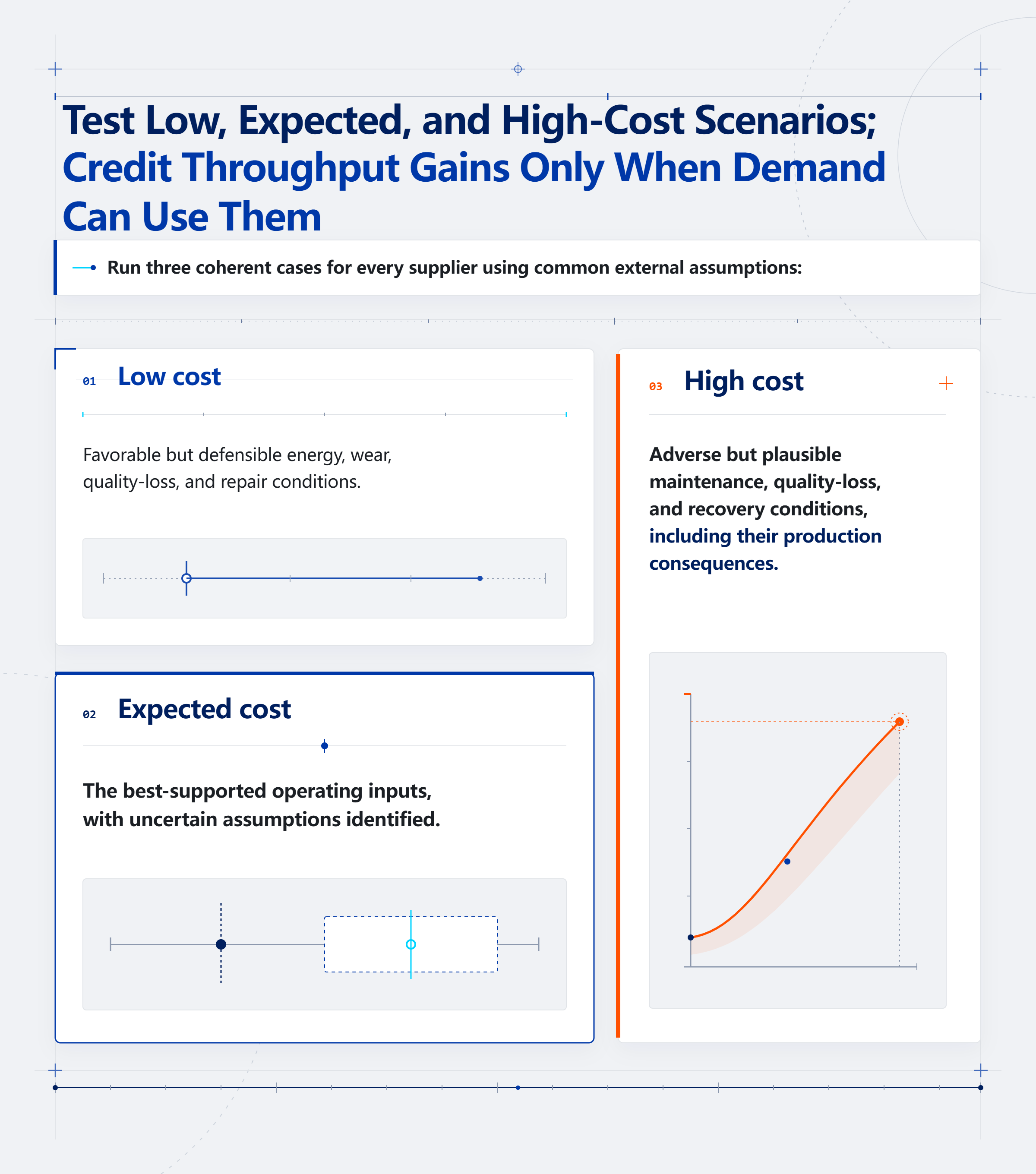
Run three coherent cases for every supplier using common external assumptions:
- Low cost: Favorable but defensible energy, wear, quality-loss, and repair conditions.
- Expected cost: The best-supported operating inputs, with uncertain assumptions identified.
- High cost: Adverse but plausible maintenance, quality-loss, and recovery conditions, including their production consequences.
Do not call an unsupported midpoint an expected value. Where the evidence cannot establish a likely repair frequency or component life, retain a range. Alongside the combined scenarios, vary influential assumptions individually to identify what changes the ranking. If demand or utilization changes, apply the same revised workload to every candidate and recalculate hours, losses, and capacity value.
Faster production creates financial value only when it changes spending or serves usable demand. For a hypothetical example, assume a validated reduction of 30 seconds per acceptable part across 24,000 parts annually, with setup and quality losses unchanged:
24,000 × 30 seconds ÷ 3,600 = 200 machine-hours saved per year.
Assume one dedicated operator and a schedule that allows 80 paid overtime hours to be eliminated at a marginal cash cost of $60 per hour. The labor cash saving is $4,800 annually. The remaining 120 machine-hours do not automatically reduce payroll or generate revenue.
Additional output deserves a financial credit only if there is demand for it, the press brake constrains that demand, and upstream and downstream operations can support the increase. Value those additional sales at incremental contribution, after their additional costs—not at gross revenue.
Carry the common-assumption cost result, sensitivity range, ranking-changing inputs, and evidence limitations into the final supplier matrix. Preserve technical and service evidence separately, but do not award extra economic points for an energy saving or downtime reduction already monetized in ownership cost. Any performance or support commitment essential to the preferred result should also become a documented acceptance or contractual requirement.
6. Score Qualified Suppliers and Turn the Decision into Contract Terms
Use the score to make trade-offs visible, not to excuse a failed requirement. The highest-scoring supplier becomes a defensible choice only when its evidence supports the ranking and its promised configuration, acceptance results, and support obligations become contractual commitments.
Keep Failed Mandatory Requirements Outside the Score and Hold Unresolved Critical Claims for Verification
Maintain a separate qualification register with three statuses: passed, failed, and pending verification. A failed mandatory requirement excludes the offered configuration. An unresolved critical claim—such as acceptable results on a difficult part or essential local service coverage—keeps it pending. Neither status belongs in the scored shortlist.
Record the evidence needed to clear each pending item, who must provide it, and the decision deadline. Do not assign a low score to an unverified requirement: that would allow price or another strength to compensate for something the purchase cannot proceed without. If a supplier revises its configuration to qualify, update its scope, price, and supporting evidence before scoring it.
Start with Adjustable Weights: Proven Performance 30%, Service 25%, Ownership Cost 25%, Usability 10%, Delivery Certainty 10%
Start with 30% proven performance, 25% service, 25% ownership cost, 10% usability, and 10% delivery certainty. These are adjustable decision weights, not industry benchmarks. Set them around your production risks before viewing supplier totals, and keep the total at 100%.
Weights govern trade-offs among acceptable offers. For example, heavier service weighting may suit a plant with limited internal repair capability, but essential service coverage must still pass qualification. Likewise, a mandatory installation deadline remains a gate; delivery points distinguish the credibility of schedules that already meet it.
Use a Comparison Matrix with Criterion, Weight, Evidence, 0–5 Score, Weighted Result, Confidence, and Open Issues
Complete one matrix per qualified supplier using the same quote revision, workload assumptions, and scoring rules. Agree the anchors in the next subsection before entering ratings.
| Criterion | Weight | Evidence | 0–5 score | Weighted result, points | Confidence | Open issues |
|---|---|---|---|---|---|---|
| Proven performance | 30% | Part-test records; defined advantages not already monetized | — | 30 × score ÷ 5 | — | — |
| Service | 25% | Verified local capability; responsibility, escalation, and parts commitments | — | 25 × score ÷ 5 | — | — |
| Ownership cost | 25% | Common-assumption cost model, normalized quote, and sensitivity range | — | 25 × score ÷ 5 | — | — |
| Usability | 10% | Operator trials of programming, setup guidance, and fault recovery | — | 10 × score ÷ 5 | — | — |
| Delivery certainty | 10% | Configuration-specific build, shipping, installation, and commissioning schedule | — | 10 × score ÷ 5 | — | — |
| Total | 100% | Sum, out of 100 |
Each contribution equals the weight in percentage points multiplied by the score divided by five. A hypothetical performance rating of 4 therefore contributes 30 × 4 ÷ 5 = 24 points. The dashes are fields to complete, not zeroes.
Use evidence identifiers—test report, quote revision, reference-call record, or proposed contract clause—rather than comments such as “good support.” Mark confidence separately: high for direct, applicable verification; medium for supported evidence with a stated limitation; low where corroboration remains insufficient. Confidence describes the basis for the score; it is not another numerical multiplier.
Missing evidence is “pending,” not a zero rating. Leave unsupported claims unscored, hold critical claims at qualification, and do not compare final totals until every finalist has a supported rating on the same criteria. Assign an owner and closure action to each open issue.
Define Scoring Anchors Before Rating Suppliers and Avoid Rewarding the Same Benefit Twice
Write criterion-specific definitions for all six ratings before the team scores suppliers. A useful structure for discretionary attributes is:
| Score | Anchor |
|---|---|
| 0 | Evidence shows no value against the stated preference |
| 1 | Provides limited value with substantial shortcomings |
| 2 | Partly meets the defined target |
| 3 | Meets the defined target |
| 4 | Exceeds the target in a specified, useful way |
| 5 | Meets the predefined stretch target, demonstrated under agreed conditions |
These anchors do not replace mandatory limits. A rating below 3 can reflect a missed preference, but any discovered failure of a mandatory requirement returns the offer to qualification review.
Make the distinctions observable. For a usability exercise, a 3 might mean completing an agreed program-change and recovery task correctly with specified prompts; a 5 might require correct, independent completion by a representative operator. Define the task and permitted help in advance rather than judging how polished the supplier’s demonstration looks. For ownership cost, establish common cost bands against an agreed benchmark before assigning scores.
Assign each benefit one scoring home. If reduced setup time or downtime already improves ownership cost, do not award additional points for the same economic benefit under usability or service. Those categories can assess separately defined attributes, such as operator independence or contractual accountability. A test report may support several criteria, but each criterion must reward a different outcome. Remove or reweight any criterion that merely repeats value already counted elsewhere.
Resolve Close Results with Sensitivity Checks, Additional Tests, References, or Revised Quotes
Treat a narrow lead as a question about decision stability, not proof of superiority. Vary the weights within ranges the buying team considers reasonable, keeping the total at 100%. Recheck cost assumptions within their supported ranges. Record which changes reverse the ranking and whether those changes reflect a plausible operating situation.
Then investigate the uncertainty that matters:
- Performance gap: Run the additional part or repeatability test that could change the rating.
- Service gap: Check a relevant reference and confirm who would actually diagnose, attend, and supply parts.
- Cost gap: Obtain a revised quote or firm scope clarification rather than guessing at an omission.
- Delivery gap: Request evidence behind the schedule, including dependencies and commissioning resources.
Do not add decimal places to manufacture certainty. If plausible assumptions keep changing the winner, document the trade-off management is choosing. If one unresolved fact controls the outcome, verify that fact before award.
Complete the Selection Checklist: Confirm Configuration, Close Scope Gaps, and Agree Factory and Site Acceptance Tests
Before approving the preferred supplier, confirm that the offer being purchased is the offer that earned the score:
- Freeze the configuration. Identify the machine, axes, controls, software and licenses, tooling and holders, safety equipment, handling aids, and accessories. Specify relevant revisions.
- Close scope gaps. Allocate freight, unloading, rigging, utilities, installation, commissioning, training, and other responsibilities. Price unresolved commercial items; reject allowances as substitutes for unresolved technical qualification.
- Reconcile changes. Confirm that substitutions or quote revisions have not invalidated trials, service arrangements, ownership-cost inputs, or delivery commitments.
- Agree factory acceptance testing. Define the pre-dispatch tests, required records, buyer witness rights, and conditions for shipment release.
- Agree site acceptance testing. Define what must be demonstrated after installation at your plant. Factory results should not automatically establish that installation and site integration are acceptable.
- Define the test conditions. Specify part drawing revisions, material conditions, tooling, programs, sample quantities, repetition, operator involvement, inspection methods, and permitted adjustments.
- Define failure handling. State who records defects, pays for corrective work and retesting, and authorizes closure.
The test plan must distinguish producing one acceptable sample from sustaining the required production result. Where throughput matters, define acceptable output, elapsed time, staffing, setup boundaries, and treatment of rejected or reworked parts.
Put Acceptance Limits, Documentation, Training, Warranty Start, Support Commitments, Remedies, and Payment Milestones in the Contract
Attach the agreed configuration, scope schedule, acceptance procedures, and support commitments to the contract. Establish which document controls if the quotation, specification, and standard terms conflict. A scoring note or sales email should not be the only record of a promise essential to selection.
Include these terms explicitly:
- Measurable acceptance limits: Required part dimensions and tolerances, repeatability measures, output and setup targets where applicable, required machine and safety functions, inspection methods, and pass/fail rules. Use your validated requirements—not an unsupported universal allowance.
- Documentation deliverables: Operating and maintenance manuals, applicable drawings, maintenance schedules, spare-parts information, required compliance records, and agreed software backups, access rights, and license terms. State delivery format and timing.
- Training scope: Roles covered, participants, duration, location, language, included materials, and how completion or competence will be demonstrated.
- Warranty terms: The start event—such as signed site acceptance—duration, coverage, exclusions, claim procedure, and responsibility for diagnosis, labor, travel, parts, and freight.
- Support commitments: The accountable organization, coverage hours, contact route, escalation process, and measurable response obligations. Distinguish acknowledging a call, beginning diagnosis, dispatching a technician, arriving on site, and restoring operation; these are different commitments.
- Remedies: Correction and retest deadlines, responsibility for associated costs, and agreed rights if failures remain unresolved or delivery obligations are missed.
- Payment milestones: Defined progress or acceptance events and the evidence required for each payment. Retain a negotiated unpaid balance until the corresponding acceptance obligations are satisfied, and specify how open defects affect payment.
Approve the purchase when the qualification register is clear, the ranking rests on traceable evidence, and every promise essential to the decision has a contractual owner, measurable obligation, and agreed consequence for nonperformance.