
Where are shearing machines used in production?
Shearing machines cut straight-edged sheet and plate blanks for fabrication, construction, appliance and automotive production, and heavy-equipment work. Typical outputs include rectangular blanks for bending or welding, roofing and flashing blanks, duct panels, enclosure panels, and straight plate sections. Purpose-built scrap shears serve a different role: reducing discarded metal to manageable sizes.
A blank is a piece of stock cut for later processing. Shearing usually prepares that starting piece rather than completes the finished component.
Related: Hydraulic Shearing Machine Guide
General fabrication: cutting blanks before bending, stamping, or welding
Fabrication shops use shears to turn larger sheets into rectangles, squares, and strips with repeatable dimensions. Those blanks then move to bending, stamping, or welding operations. A simple bracket, for example, can start as a rectangular sheared blank before holes are punched and a bend creates its final shape.
The useful boundary is the required geometry: a straight-cut blank suits shearing; holes, curved outlines, and intricate profiles require another operation. Sheared edges can also carry burrs or distortion, so the next production step determines whether deburring or further finishing is needed.
Construction and HVAC: sizing roofing, flashing, duct panels, and housings
In construction and heating, ventilation, and air-conditioning work, shearing sizes flat stock for roofing, flashing, duct panels, and equipment housings. These products often begin with straight-edged pieces that are subsequently folded, formed, or joined.
For flashing, the shear establishes the blank’s length and width; bending produces the section that fits the building detail. Similarly, a duct-panel blank must include the material needed for its bends and seams—not merely match the finished face dimensions. Shearing supplies the flat shape specified by that layout.
Appliances and automotive: preparing panels, enclosures, and formed-part blanks
Appliance and automotive production use shearing to prepare panel stock, enclosure blanks, bracket blanks, and other material for forming or assembly. Its value is repeatable stock preparation when the next operation can start from a straight-edged piece.
That does not mean a shear produces the final outline of every body panel or enclosure. A part with a shaped perimeter or internal openings needs additional cutting or punching. Visible or closely fitted edges may also require finishing beyond the as-sheared condition.
Shipbuilding and heavy equipment: cutting straight plate sections within machine capacity
In shipbuilding and heavy-equipment fabrication, suitable plate shears cut straight sections for deck, hull, frame, and support work. These pieces may then undergo forming, weld-edge preparation, and assembly.
The application is conditional on capacity: the machine must accommodate the material’s strength, thickness, and required cut length. A shear suited to thin sheet is not interchangeable with a heavy-plate machine. Curved profiles or plate beyond the machine’s rated capability call for another cutting process.
Recycling: reducing scrap size rather than producing precision parts
Recycling shears reduce discarded metal into pieces that are easier to handle, transport, and prepare for further processing or remelting. Here, the goal is manageable scrap size rather than an accurate blank ready for forming.
Irregular scrap therefore calls for purpose-built equipment, not an assumption that a production sheet shear will do the same job. The contrast explains why “shear” describes several machine designs: cutting flat blanks and breaking down bulky scrap impose different feeding, holding, and cutting demands.
Which shear design fits the stock and cut?
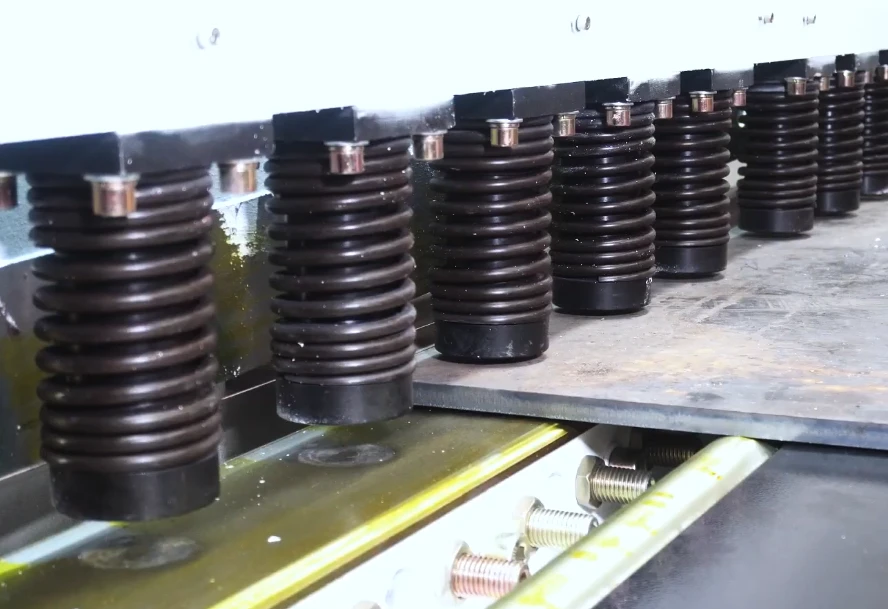
Choose the shear family by stock shape and the required cut, not by the word “shear” alone. Flat blanks, continuous coil strips, and shortened bars or scrap require different ways to feed, support, and hold the metal.
Guillotine and swing-beam sheet shears: straight cuts through sheet and plate
Both designs suit straight-line cutting in flat sheet and plate. They hold the stock against a table while a moving blade passes a fixed blade, separating the material along the cutting line. Choose this family for sizing flat blanks before forming or welding; for a CNC-based option within a broader sheet-metal workflow, explore ADH Machine Tool’s shearing machines.
The distinction is blade motion:
- A guillotine shear moves its upper blade along a straight, guided path.
- A swing-beam shear carries its upper blade through an arc around a pivot.
Both produce straight cuts; the pivoting motion does not make the swing-beam machine a contour cutter. Neither design is universally superior. Compare the actual machine’s stock support, hold-down system, blade-clearance adjustment—the gap between the cutting edges—and cut results on the intended material. Secure holding limits sheet movement, while suitable clearance helps control burrs and edge deformation. The design name alone does not guarantee edge quality.
If you are comparing shears for a specific material and cut, ADH Machine Tool’s CNC shearing range makes it a relevant supplier to evaluate. Contact ADH Machine Tool to discuss your stock, required edge quality, and a suitable configuration.
Rotary slitting shears: dividing coil into continuous strips
Choose rotary slitting equipment when the input is a wide coil and the required output is narrower, continuous strip. Paired circular knives cut lengthwise as the metal feeds through the line. Their positions across the coil establish the strip widths, allowing several strips to be produced in one pass.
This is a different operation from cutting separate strips off a flat sheet. A slitting line must guide the moving material and control tension as the strips separate and, where required, rewind. Knife setup and material handling therefore matter alongside cutting capacity.
Slitting establishes width, not finished piece length. If the next operation needs fixed-length pieces rather than continuous strip, a separate cross-cutting operation is required.
Alligator and specialized section shears: processing scrap, bars, and profiles
An alligator shear uses a hinged jaw to cut suitable scrap or bar stock into shorter lengths. Its fit is length reduction for handling or recycling, rather than precision sheet blanking.
Specialized section shears use cutting stations or tooling matched to particular bars and profiles, such as angle or channel. The tooling supports the section during cutting; an unsupported shape can shift, crush, or distort. A rating for solid bar does not establish suitability for pipe or every structural profile.
Check that the manufacturer approves the stock shape and tooling combination. If the cut must preserve a hollow section or produce an accurately fitted end, assess sample cuts and whether sawing would better meet the requirement.
Stock geometry identifies the machine family. Material strength, thickness, and the required cut length or section size then determine whether a particular machine can do the job.
Which materials can you shear successfully?

Mild steel, many stainless steels, aluminum, copper, and brass are common shearing candidates—but a thickness rating is not permission to cut every metal at that thickness. Successful shearing depends on the actual grade, strength, and condition of the stock, as well as the machine’s limits. Ductile materials—those that can deform before fracturing—are generally better candidates than brittle materials that may crack unpredictably.
Mild steel, stainless steel, and aluminum: why capacity changes with grade and strength
A shear rated for a stated thickness of mild steel is not automatically rated for that thickness of stainless steel. Stronger stock generally requires more cutting force at the same thickness and cut length. Stainless and high-strength steels therefore commonly have lower allowable thicknesses than the mild steel listed in a machine’s specifications. Because ADH Machine Tool offers CNC shearing equipment, its downloadable brochures are a useful next step when comparing machines for your material and production needs; confirm grade-specific capacity against the relevant machine specifications.
Aluminum often requires less cutting force than mild steel, but “aluminum” is not a complete material specification. Alloy and temper—the condition produced by heat treatment or mechanical working—affect strength and cutting behavior. Likewise, stainless grades do not all impose the same load. Confirm the actual material properties rather than applying a universal conversion between metals; easier cutting also does not guarantee freedom from burrs or distortion.
Copper, brass, and coated sheet: checking temper, surface marking, and edge requirements
Copper and brass are commonly shearable, but temper can change both the load and the result. Softer stock generally cuts more easily, while harder tempers may require closer attention to blade clearance and wear. Softness alone does not ensure a finished edge: stock can still deform during cutting, and visible faces can pick up handling or hold-down marks.
Coated sheet adds a separate acceptance requirement. Galvanized or vinyl-coated stock may be within the shear’s mechanical capacity yet suffer scuffing, coating damage, or blemishes near the cut. Cutting also exposes the underlying metal at the edge. Where appearance or corrosion protection matters, check sample cuts against the part specification and determine whether edge treatment or coating repair is required. A coating on the sheet face does not establish that the cut edge meets the protection requirement.
Thickness and full cut length: interpreting the manufacturer’s capacity rating
Read the capacity rating as a combination of material strength, thickness, and rated cutting length, not as an isolated maximum thickness. The required cut length is the distance along the cut in one stroke, not the sheet’s other dimension. Cutting load and its distribution change with the length engaged and the shear’s blade geometry.
Before approving a job, compare these details with the manufacturer’s capacity table or obtain confirmation:
- The material grade, temper or heat-treated condition, and specified strength.
- The stock thickness, including its tolerance.
- The required cut length and any restrictions on where the stock may be placed.
- The approved blades and setup for that material.
A shorter cut does not automatically permit thicker stock. A manufacturer may publish different capacities for different cutting lengths, but reduced length does not remove blade, hold-down, or structural limits. Do not infer an increased thickness allowance from spare blade length or nominal machine force.
Brittle or hardened materials: confirming suitability rather than assuming metal is shearable
Hardened tool steels, very hard alloys, and brittle materials such as cast iron are suitability checks, not routine candidates for a sheet shear. They may crack outside the intended line, break unpredictably, or chip the blades. Being thinner than the listed mild-steel capacity does not resolve those risks.
If hardness or ductility is uncertain, identify the material and its condition before cutting, then confirm suitability with the machine manufacturer. Do not use an unapproved trial cut to discover whether hardened stock is acceptable; another cutting process may be necessary.
Manufacturer approval establishes that the machine can cut the stock under the specified conditions. It does not establish that the resulting burr, edge shape, or distortion is acceptable for the next operation.
What cut quality can you expect?

Shearing can produce straight-cut blanks ready for the next operation, but a sheared edge is not a precision-machined edge. Acceptable quality depends on both the cut face and the blank’s shape: a clean-looking edge does not prove that the part is square, flat, or within dimensional tolerance.
How opposing blades separate metal without a heat-affected zone
Opposing blades pass one another with a small gap between them. They first compress and permanently deform the metal near the cutting line. As the blades penetrate, cracks develop and extend through the remaining thickness until the pieces separate.
Shearing does not rely on melting or heating the stock, so it creates no thermal heat-affected zone—the region beside a thermal cut whose properties change because of cutting heat. That does not leave the edge unchanged. The blades mechanically deform and fracture it, producing features that can affect fit-up, subsequent forming, handling, and appearance.
Rollover, fracture, and burrs: why a sheared edge is not a machined edge
Across its thickness, a typical sheared edge shows these features:
- Rollover: a rounded area on the blade-entry side, where the metal bends and compresses before separation.
- Burnished zone: a smoother band formed as the blade penetrates and rubs against the metal.
- Fracture zone: a rougher region where cracks complete the separation rather than the blade cutting smoothly through.
- Burr: a possible sharp projection at the exit side, where the last connected metal tears away.
These features do not occupy fixed proportions of the thickness. Material behavior, blade clearance, and blade condition change their size and appearance. The fracture face may also slope rather than remain square to the sheet surface.
A visible fracture zone is normal, not automatically a defect. Judge it against the part’s function: an irregular edge may interfere with close fit-up, while a burr can prevent mating surfaces from seating or create a handling hazard. A rough blank destined for further trimming has different acceptance requirements from an exposed finished edge.
Bow, twist, and narrow-strip distortion: effects of blade clearance, rake, and hold-downs
Blade clearance—the gap between the cutting edges—controls how far the metal deforms before it separates. Too much clearance lets the stock bend farther, tending to increase rollover, fracture angle, and burr. Too little raises cutting force and can produce secondary shearing marks or a ragged edge. Use the manufacturer’s clearance guidance for the material and thickness, rather than treating the smallest gap as the best finish setting.
Blade condition matters alongside clearance. A dull edge compresses more metal before penetrating, which can worsen rollover and burrs. Uneven clearance, damaged blades, or stock movement can also produce inconsistent edges. A large burr therefore calls for inspection of the setup, not an automatic clearance adjustment.
Rake is the blade inclination that makes the cut progress along its length instead of engaging the entire cutting line at once. This reduces the length cutting simultaneously and therefore lowers peak cutting force. The tradeoff is that the progressively separating piece can bend or rotate. Thin, narrow strips offer less resistance to that deformation and are particularly vulnerable to bow, or curvature along their length, and twist, where their cross-section rotates along the length.
Hold-downs restrain the sheet against lifting or sliding as the blades load it. Correct restraint helps stabilize the cut, but it does not fully support the separating offcut. Stock and offcut support must suit the geometry; more clamping pressure is not a general cure for distortion and may mark the surface. Check the actual strip width and length required by the job, not just a convenient wide sample.
Dimensional consistency and finishing: checking backgauge accuracy and deburring needs
The backgauge positions the stock at a set distance from the cutting line. Its positioning accuracy is only one part of finished-part accuracy. The stock must seat consistently against it, the reference edge must be suitable, and alignment and support must keep the sheet square. Movement during cutting or distortion after separation can still leave a blank outside tolerance even when the gauge repeats its position accurately.
Once the material and setup are approved, verify representative sample cuts against the drawing:
- Measure the cut dimension at several locations and check squareness to the specified reference edge.
- Check the released blank for flatness, bow, and twist—not only while it is restrained.
- Inspect burr height and location, rollover, edge irregularity, and hold-down marks.
Repeat the relevant checks after changes to material, clearance, rake, blades, or hold-down settings.
Finishing follows those results. Deburr when sharp projections compromise handling, seating, coating, or the next operation. Flatten when distortion exceeds the part’s permitted shape limits. Use machining or another suitable edge-finishing process when the cut face itself needs a tighter finish or geometry. None of these steps is automatically required for every sheared blank.
The production decision is therefore larger than whether the shear can make the cut: compare shearing plus any necessary finishing with a process that may deliver the required part more directly.
When is shearing the right process—and when is it not?
Start with shearing for repeated rectangular blanks and straight cuts, provided the machine is approved for the material, thickness, and cut length. Compare another process when the required geometry or corrective work outweighs shearing’s cutting-speed advantage. The useful measure is cost per acceptable blank ready for the next operation—not cost per blade stroke.
Repeated straight cuts and rectangular blanks: where speed and low cost per cut can pay off
A straight-blade shear separates material along a line in one stroke rather than tracing the edge with a cutting head. Repeated dimensions let the operator reuse gauge settings, while batch production spreads setup time across more blanks. These mechanisms make shearing a strong candidate for rectangular panels, plate blanks, strips, and edge trimming.
That advantage depends on what happens between strokes. Loading, repositioning, supporting, and stacking the material can take longer than cutting it. A fast shear does not necessarily deliver fast production if each blank requires awkward handling or substantial finishing.
Choose shearing when the blank can proceed to forming, welding, or assembly with acceptable dimensions, flatness, and edges—or with modest, justified finishing. For a production comparison, time a representative batch from stock loading to usable blanks, rather than comparing advertised stroke rates.
Curves, holes, and intricate profiles: choosing laser, plasma, waterjet, or punching instead
Conventional straight-blade sheet shears cannot make internal holes or intricate curved profiles. For those features, compare processes against the actual drawing:
- Laser cutting: A candidate for detailed outlines and small features, particularly in thin-to-medium stock. Suitable thickness and feature size depend on the alloy and machine. Because the process uses heat, check whether the resulting edge condition suits subsequent forming, welding, or finishing.
- Plasma cutting: A candidate for electrically conductive metal plate, including thicker structural work. Compare its ability to produce the required detail and edge squareness, not just its ability to cut through the thickness. Heat effects and edge cleanup may matter.
- Abrasive waterjet cutting: A candidate for complex metal profiles when cutting heat must be avoided. It creates no thermal heat-affected zone, but that does not guarantee a finished edge: thickness, cutting speed, and quality settings affect surface finish and taper—the change in cut width through the thickness.
- Punching: A candidate for repeated holes and formed features in sheet within the press and tooling limits. Tool shape, required force, and spacing between features constrain the design. Repeated use of suitable tooling can favor punching, while tool changes, burr removal, and distortion can add work.
Holes alone do not rule out shearing the outside rectangle. Shearing followed by punching may be economical when both operations repeat efficiently. A profile-cutting machine may instead produce the outline and openings in one setup. Compare those complete routes rather than assuming every feature must come from one machine.
Tight tolerances and heavy stock: comparing cutting and finishing as one workflow
A tight requirement on one machined edge does not necessarily justify precision cutting around the entire blank. Shearing oversize stock and milling only the critical edge may be the better route. Conversely, if several edges need correction and the blank also needs flattening, a more expensive initial cut may reduce total work.
Compare each route to the same finished requirement. Include setup, handling, cutting, deburring, flattening, machining, and inspection wherever they are necessary. Do not assume the alternative process eliminates finishing: thermal cuts may need edge preparation, and waterjet cuts may need taper or surface-finish correction.
Heavy stock makes this comparison especially dependent on handling and edge preparation. Loading, turning, and transferring a plate can outweigh a short cutting cycle. Where machining is required, specify enough extra material for cleanup based on the expected cut variation and finished geometry; there is no universal allowance that suits every thickness and process.
The choice is therefore not “fast shear versus slow precision cutter.” It is the least costly capable sequence that delivers the drawing requirements consistently.
Material utilization: when nesting profiles beats shearing rectangular blanks
Nesting means arranging part outlines on a sheet to reduce unused material. Irregular profiles may fit together more closely than their surrounding rectangles. Cutting those profiles directly can avoid the scrap created by shearing individual rectangular blanks and then trimming each one to shape.
Rectangles and strips already suit shearing layouts well. Shearing also removes no strip of material along the cut line, unlike processes that create a kerf, or cut width. That benefit does not eliminate losses from edge trimming, stock-size mismatch, or unusable remnants.
Compare layouts using the actual part mix and available stock sizes. Allow for cutting gaps, edge margins, and any required material direction for later forming. Count the material remaining in acceptable finished parts—not merely the area converted into rough blanks.
Carry the preferred route into the purchasing specification: define the stock range, part geometry, required output, and acceptable finishing burden. Then use a representative sample-cut test to check the assumptions behind that choice, rather than buying on nominal cutting capacity alone.
How do you choose a machine for your application?
Buy against a written job specification and an agreed acceptance test—not a maximum-thickness headline. A suitable shear must meet the cutting requirements while fitting the shop’s handling capacity, staffing, and maintenance resources.
Define the job: material grade, thickness, cut length, tolerances, and daily volume
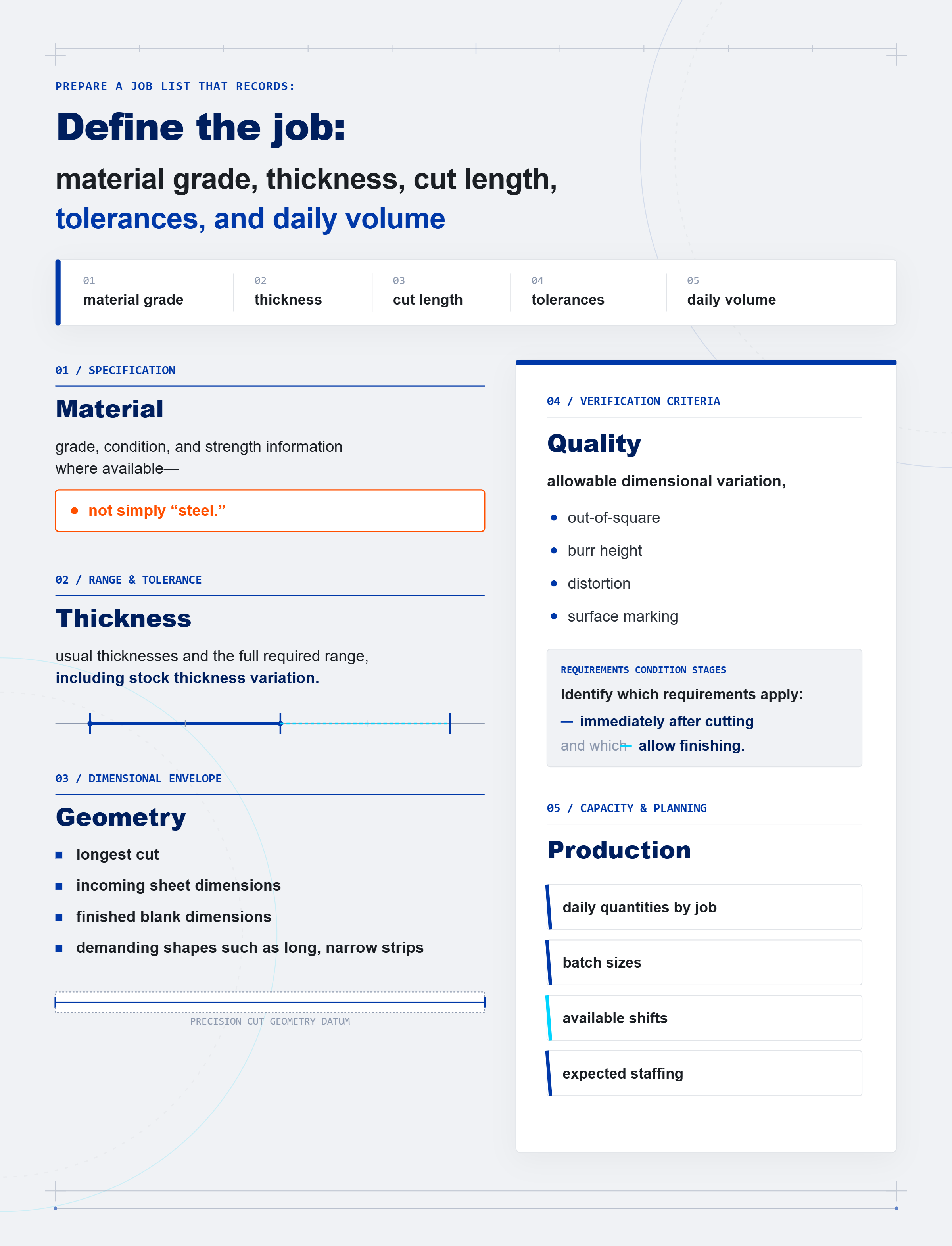
Prepare a job list that records:
- Material: grade, condition, and strength information where available—not simply “steel.”
- Thickness: usual thicknesses and the full required range, including stock thickness variation.
- Geometry: longest cut, incoming sheet dimensions, finished blank dimensions, and demanding shapes such as long, narrow strips.
- Quality: allowable dimensional variation, out-of-square, burr height, distortion, and surface marking. Identify which requirements apply immediately after cutting and which allow finishing.
- Production: daily quantities by job, batch sizes, available shifts, and expected staffing.
Identify the combinations that actually occur. The thickest material, strongest grade, and longest cut may belong to different jobs; list each demanding case separately so the supplier can confirm coverage.
Prioritize the work that fills most production hours, but explicitly decide how to handle occasional jobs beyond the proposed machine’s capacity. Outsourcing those jobs may be reasonable; treating an inadequate rating as something operators can work around is not.
Compare manual, mechanical, and hydraulic machines by rated capacity and duty cycle
Ask for documented capacity covering the actual material strength, thickness, and cut length together. A mild-steel thickness rating does not establish the same capacity for stainless steel. Nor does capacity prove that the resulting blank will meet its dimensional or edge requirements.
Use drive type to guide the questions, not to decide the purchase:
| Machine type | What to verify |
|---|---|
| Manual | Whether operator effort, positioning, and handling remain practical for the required stock and daily quantity. Low purchase cost does not establish adequate production capacity. |
| Mechanical | Whether the rated operating cycle suits the job mix and whether feeding, gauging, and discharge can keep pace with repeated strokes. |
| Hydraulic | Whether cutting speed, available adjustments, cooling, and maintenance requirements suit the intended workload. Hydraulic drive alone does not guarantee accuracy or thicker-stock capability. |
Check **duty cycle—the permitted pattern of operation and rest—**under the manufacturer’s stated conditions. Ask whether the proposed model can sustain the planned workload, including any cooling or rest requirements. Keep three things separate: the job’s required output, the machine’s documented operating limits, and the production rate demonstrated during testing.
Match backgauge automation, sheet supports, and handling equipment to production needs
A backgauge is the positioning stop that sets the cut dimension. Programmable positioning is useful when operators repeatedly change dimensions or run sequences of cuts. Check its travel range against the smallest and largest required blanks, and verify finished-part repeatability rather than relying only on the positioning specification.
Choose sheet supports and loading aids around stock size, weight, and operator workload. They must keep material supported and controlled as it moves into position; a suitable shear can still be a poor purchase if the planned crew cannot load or align its stock safely.
Include discharge in the equipment layout. Specify how blanks, offcuts, and scrap will be supported, separated, and removed without reaching into hazardous areas. Confirm that carts, lifting equipment, support tables, and collection space fit the available floor area.
Validate sample cuts and check guarding, operator training, and service support
Agree on the test materials and acceptance limits before ordering. Use representative stock within the machine’s documented capacity, covering routine jobs and demanding combinations of grade, thickness, and cut length. Include the narrowest or longest strips the shop actually needs—not just easy demonstration blanks.
Inspect the samples for:
- Dimensions, squareness, and consistency across repeated cuts.
- Burrs and edge condition.
- Bow, twist, and loss of flatness.
- Surface marking.
- Fit and performance in the next forming, welding, or assembly operation.
Record the trial settings and any finishing needed to achieve acceptance. Run a representative batch with the proposed handling equipment and staffing to check whether acceptable blanks can be produced at the required rate.
Treat safeguarding as a purchase requirement. Review guards, emergency stops, safe feeding and discharge, and access around the machine with a competent safety reviewer. Require operator training and manufacturer-specific procedures, including isolation and lockout/tagout for maintenance; a sample-cut demonstration is not a substitute for either.
Confirm installation and power requirements, maintenance intervals, blade servicing arrangements, spare-parts availability, warranty terms, and service support. Ensure routine maintenance can be performed safely in the proposed layout.
Make purchase acceptance conditional on documented capacity and representative trials meeting the agreed requirements. Choose the machine and handling package that delivers usable blanks safely, at the required volume, with an acceptable finishing burden—not the machine advertising the greatest thickness.