
Which materials can a sheet-metal shear cut?
A sheet-metal shear can cut many grades of mild steel, stainless steel, aluminum, copper, and brass, including many galvanized or painted sheets. A material name alone does not establish a safe thickness limit or an acceptable finished edge. The actual grade, temper, thickness, and cut length must fall within the machine’s material-specific capacity and its blade limits.
Shearing separates sheet between cutting edges rather than removing a strip of material. Its results depend on both material strength and setup. Temper describes the material’s condition after treatments such as cold working or heat treatment; blade clearance is the gap between the cutting edges. Stronger stock demands more cutting force, while softer stock can smear or deform even when the machine has ample capacity.
Before selecting a shear, give the supplier your stock specification, longest required cut, and edge-quality requirements. With more than 50 sales and service points in China and overseas, ADH Machine Tool is a supplier to contact about these requirements and ask for model-specific confirmation of suitable blades and settings. Request approved tooling, then confirm the result with trials on your actual stock, not by testing whether the machine can force through an unapproved material.
Material comparison table: suitable shear, capacity limits, blade setup, and edge-quality risks
The families below are candidates, not approvals for every machine in that family. Guillotine shears use a long blade for straight cuts; bench or lever shears suit smaller work within their ratings. Rotary shears use circular cutting edges, with the arrangement determining whether they slit strips or trim contours. Manual, mechanical, or hydraulic operation does not by itself establish material capacity.
| Material | Suitable shear families, subject to rating | Conditional capacity limits | Blade and setup considerations | Likely edge or surface risks |
|---|---|---|---|---|
| Mild steel | Bench/lever; mechanical or hydraulic guillotine; rotary slitter | Verify steel grade, thickness, and cut length against the stated rating | Sharp, approved blades; specified clearance and hold-down settings | Burrs, edge rollover, bowing or twisting |
| Stainless steel | Guillotine or rotary slitter specifically rated for stainless; bench shear only where explicitly rated | Do not transfer a mild-steel thickness rating to stainless; verify grade and condition | Approved wear-resistant blades; controlled clearance; monitor wear | Burr growth, rough edges, distortion, accelerated blade wear |
| Aluminum | Bench/lever, guillotine, or rotary shear rated for the alloy and thickness | Check alloy and temper; easy cutting does not guarantee a mark-free part | Sharp, clean blades; approved clearance; clean supports and hold-downs | Smearing, galling—metal sticking to the blade—surface marks, rollover |
| Copper | Rated bench/lever, guillotine, or rotary shear | Verify thickness and temper rather than treating all copper sheet alike | Sharp blades; controlled gap; support sheet and cut pieces | Blade drag, burrs, marking, distortion |
| Brass | Rated bench/lever, guillotine, or rotary shear | Check alloy and temper; harder conditions can change force and edge behavior | Approved blade geometry and clearance; adequate support | Drag, deformation, or edge cracking in less ductile conditions |
| Galvanized or coated steel | Steel-rated bench/lever, guillotine, or rotary shear | Verify the base steel’s grade and thickness; assess coating acceptance separately | Sharp blades; approved clearance; clean contact surfaces | Coating scuffing, flaking, drag, and exposed metal at the cut edge |
| Hardened or heavily work-hardened steel | Only equipment and tooling explicitly approved for the stock | An ordinary mild-steel rating is not approval | Obtain material-specific machine and blade confirmation before cutting | Blade chipping, overload, cracking, poor edge quality |
| Plastics and composites | Dedicated or explicitly approved shearing equipment | No capacity can be inferred from a metal rating; composition and construction matter | Material-specific tooling, support, and trials | Cracking, crushing, splintering, or layer separation |
A restricted material is not a candidate for trial cutting on an unapproved machine. If approval is unavailable—or the required finish cannot tolerate shear marks—evaluate another cutting process.
Mild and galvanized steel: check steel grade and protect coated surfaces
A mild-steel rating is a reference condition, not permission to cut every steel at that thickness. Confirm what grade or strength the rating assumes and whether it covers your required cut length. Higher-strength sheet may exceed that basis even when its dimensions match.
For coated steel, judge the base-metal edge and the coating separately. A cleanly separated sheet can still fail inspection because the paint flakes or the galvanized surface is scuffed. Excessive clearance can worsen tearing and coating drag, but “tighter” is not an unlimited remedy: use the approved clearance range. Shearing also exposes the base metal at the cut edge, so check whether the finished application requires edge protection.
Stainless steel: verify grade-specific capacity and blade wear resistance
Stainless steel commonly demands more cutting force than mild steel and can harden as it deforms. That makes a mild-steel capacity label an inadequate basis for purchase. Request confirmation for the actual stainless grade, thickness, condition, and cut length, along with a compatible blade specification.
Blade durability also affects usable output. If burrs increase during a run, inspect blade condition and clearance before assuming that more force will solve the problem. Wear-resistant tooling must still suit the machine and withstand the cut; choosing a harder blade without checking compatibility is not a reliable fix.
Aluminum: account for alloy and temper, galling, and surface marking
Aluminum illustrates why capacity and quality are separate decisions. A softer sheet may require less force yet suffer more marking or edge rollover; a harder temper may resist deformation but demand more capacity. Specify both alloy and temper when requesting a machine recommendation.
For a cosmetic part, include surface inspection in the trial. Smears or recurring scratches can point to blade buildup, damaged cutting edges, or dirty contact surfaces. Check those conditions alongside approved clearance and hold-down settings. Increasing clamping pressure indiscriminately may exchange sheet movement for visible impressions.
Copper and brass: match temper and control blade drag and distortion
Copper and brass are commonly shearable, but soft stock can drag against the blades and bend as it separates. Temper and, particularly for brass, alloy composition affect the result. Sharp blades, correct clearance, and support for both the sheet and cut piece help control deformation.
Trial the intended part geometry, not just a convenient scrap coupon. A narrow strip may curl or twist even when a wider test piece looks acceptable. Inspect burrs, straightness, flatness, and surface condition against the part requirements. If approved setup changes cannot meet those requirements, the limitation may be the process or geometry rather than insufficient machine power.
Once material compatibility is established, use the table’s shear-family column to narrow the next choice: a machine format that fits the required cut geometry, sheet handling, and workload.
Which shear type fits your cuts and workload?
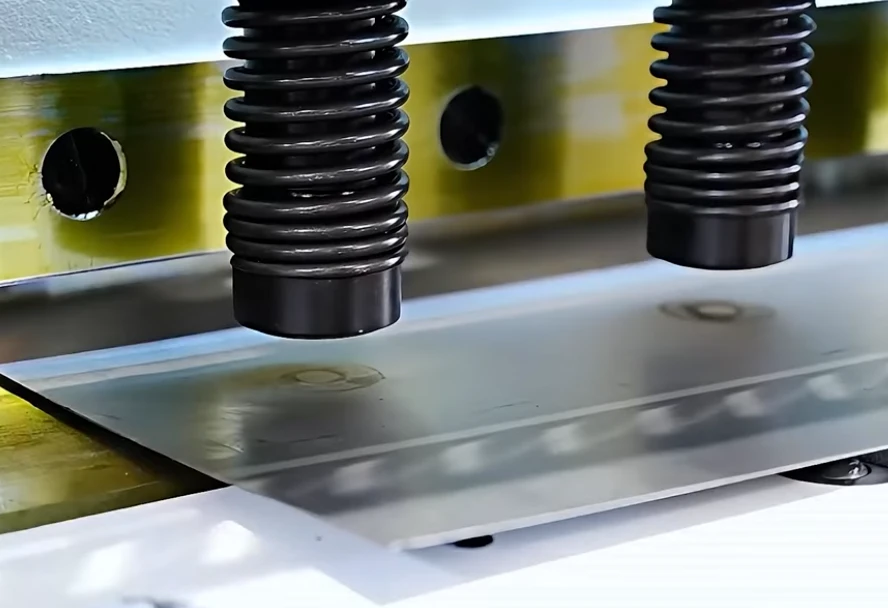
Choose the shear format for the cut geometry and production rate you need, then verify the specific model’s material capacity. ADH Machine Tool’s CNC-based shearing offering makes its shearing machine range an option to evaluate against those requirements. Judge output by the complete job—loading, positioning, cutting, and removing parts—not just how quickly the blade cycles.
Manual and bench shears for small sheets and low-volume work within rated capacity
Manual hand shears and compact bench-mounted shears suit occasional trimming, repairs, and small fabrication jobs when the stock and cut dimensions stay within their ratings. Their small footprint and simple setup can matter more than production speed for this work.
Check access as well as thickness capacity. Blade length and the machine’s frame opening can restrict where a sheet fits and how much of a cut can be completed in one stroke. A tool that handles a short trim may not suit a long, straight finished edge.
Shortlist these machines when the operator can position and support the work comfortably. If repeated manual strokes or awkward sheet handling dominate the job, compare a powered sheet shear rather than selecting a larger manual tool on thickness rating alone.
Mechanical and hydraulic guillotine shears for straight sheet cuts: compare capacity, adjustment, and production needs
A guillotine shear uses a descending blade to make straight cuts across flat sheet. Mechanical models deserve consideration for repetitive production where cycle speed matters. Hydraulic models are often useful candidates for heavier stock or frequent changes in thickness and setup. Hydraulic drive alone does not prove greater capacity or better cut quality.
Use those tendencies to build a shortlist, then compare the actual models:
| Selection factor | What to verify | Why it changes the choice |
|---|---|---|
| Material capacity and cut length | Manufacturer approval for the intended stock across the required cutting length | Neither drive type establishes the machine’s usable capacity |
| Production cycle | Cycle time for the required stroke, plus positioning and part removal | Fast blade movement provides little benefit if handling controls output |
| Setup changes | Available adjustments and the time needed to change them | Frequent material changes can make adjustment convenience more valuable than maximum cycle speed |
| Blade and clamping features | Compatible blades, approved adjustment ranges, and suitable hold-downs—the devices that clamp the sheet during cutting | Cutting force cannot compensate for unsuitable tooling or poor sheet restraint |
| Sheet and part handling | Front supports, positioning stops, and arrangements for supporting and removing cut pieces | Large sheets and awkward parts can determine staffing needs and practical throughput |
For readers shortlisting CNC shearing equipment, ADH Machine Tool includes shearing in its CNC-based product portfolio. Download its brochures as reference material when comparing models against the criteria above, then confirm material-specific capacity, compatible blades, and available adjustments with the supplier.
Hydraulic models may offer more flexible adjustment of blade clearance—the gap between the cutting edges—and rake, the blade’s cutting angle. Confirm those features on the proposed model; do not infer them from the drive label. A mechanical machine with suitable capacity and tooling may be the better purchase for a stable, repetitive job.
For a production comparison, ask suppliers to demonstrate the full work sequence on approved stock representative of your jobs. Compare acceptable parts produced, setup effort, and handling demands rather than unloaded stroke counts.
Rotary slitters for continuous strips; dedicated equipment for bars, profiles, and shaped cuts
Rotary slitters use circular knives to divide material into strips as it feeds through the machine. They fit continuous strip production, particularly from coil. They do not replace a guillotine for cutting individual blanks across flat sheet. If strips also need a specified finished length, include a separate cross-cutting operation in the equipment plan.
Bars, profiles, and tubes require equipment designed to support and cut those sections. Consider dedicated section shears or saws for bars and profiles, and suitable tube-cutting equipment for tubing. For holes, notches, and shaped outlines, compare dedicated punching, notching, or contour-cutting processes. A straight-blade sheet shear cannot gain those capabilities through extra cutting force.
The result is a machine-format shortlist, not purchase approval. Next, check each exact model against the actual grade, temper, thickness range, and full cut length; only then assess its approved tooling, settings, and trial-cut results.
How do you verify thickness capacity for each material?
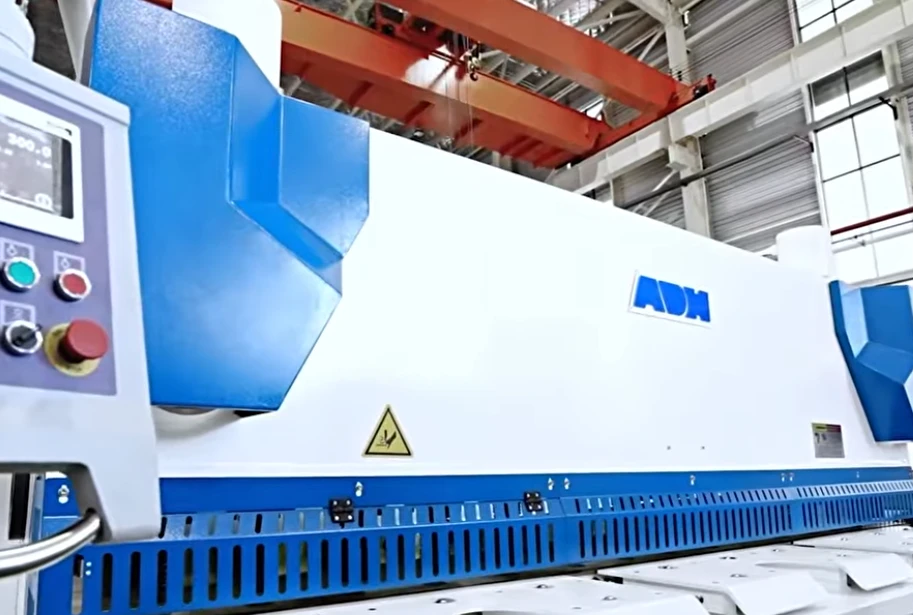
Treat a shear’s thickness rating as a conditional limit, not a promise for every sheet that fits between its blades. Verify each job against the exact model’s approved material strength, thickness, and cut length. A matching material name and nominal thickness are not enough.
Identify alloy, temper, material strength, actual thickness, and full cut length
Build a material-and-cut record before comparing capacity tables:
| Record | What to establish |
|---|---|
| Alloy or grade | The exact designation from the material certificate or supplier documentation—not simply “steel” or “aluminum” |
| Temper or heat-treatment condition | The supplied condition, which affects strength; temper describes the condition produced by thermal or mechanical treatment |
| Material strength | The strength property and range required by the shear manufacturer’s rating, using material documentation rather than a generic family value |
| Actual thickness | Measured stock thickness, plus the maximum thickness expected within the purchase tolerance |
| Full cut length | The longest cut the machine must complete in one stroke, not just the width of a trial coupon |
Do not substitute one strength property for another. If the machine’s rating specifies tensile strength but the material paperwork lists only yield strength, ask for the missing information or manufacturer confirmation.
These details can change the decision even within one alloy. Annealed stock generally requires less cutting force than a stronger, hardened condition at the same thickness. Likewise, a short sample does not establish capacity for a full-width production cut. Supply the complete record to each shortlisted machine supplier.
Read the manufacturer’s rating: mild-steel capacity does not transfer directly to other materials
A mild-steel thickness rating applies to its stated material strength and cutting conditions—not automatically to another alloy, temper, or cut length. Stainless steel or a high-strength steel grade can require more cutting force at the same thickness. Softer aluminum may require less, but that does not establish how much thicker a sheet the machine can accept.
Read the rating’s notes alongside its headline capacity. Confirm the reference material and strength, rated cutting length, and any required blade configuration, clearance, or rake setting. If the rating basis is unclear, obtain clarification rather than treating an unlabeled thickness figure as an all-material limit.
A shorter cut also does not automatically authorize thicker stock. It may reduce total cutting demand, but blade loading, machine structure, and permitted settings still impose limits. Only a manufacturer-approved reduced-length rating can establish a higher thickness allowance; unused blade length is not spare capacity you can convert yourself.
Use material-specific capacity charts rather than universal thickness or tonnage multipliers
Compare the job record with the exact model’s material-specific chart. Check that the chart covers the grade or applicable strength range, supplied condition, maximum stock thickness, and required cut length. Use separate material ratings where provided, rather than converting from mild steel with a rule of thumb.
If the chart does not cover the combination, request written confirmation from the manufacturer identifying:
- The approved material grade, condition, and strength range.
- The maximum thickness at the required cut length.
- Required blades, settings, and any operating restrictions.
Until that confirmation is available, classify the job as unverified, not “probably within capacity.” A scrap trial is not a substitute for capacity approval: completing one cut does not prove that the machine or blades stayed within their permitted loads. If the manufacturer cannot approve the combination, compare a suitably rated machine or another cutting process.
Capacity approval establishes that the machine can undertake the cut. The next decision is whether its approved blades and settings can produce the required edge and part quality—something to confirm through trials on representative, approved stock.
What blade material and setup does your sheet need?
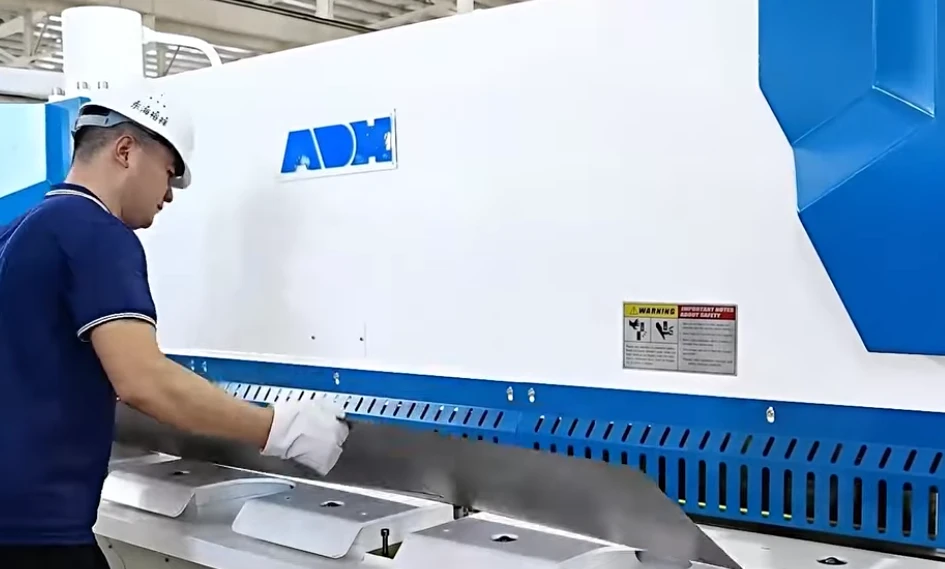
Approved capacity does not guarantee a clean cut. Your sheet also needs suitable blade steel, sound cutting edges, and manufacturer-approved clearance, rake, clamping, and support. Together, these determine how the sheet separates and whether the finished part stays flat and unmarked.
Follow the machine’s approved setup procedures. Before inspecting blades or making hands-on adjustments, isolate hazardous energy and secure moving components as the manufacturer requires; a stopped machine is not necessarily safe to enter.
Choose manufacturer-approved blade steel for the required wear resistance and toughness
Choose blade steel or inserts approved for both the machine and the intended stock—not simply the hardest blade available. Wear resistance helps an edge retain its shape as it cuts; toughness helps it resist chipping under load. Harder or more abrasive stock increases wear demand, but an overly brittle edge can chip rather than wear gradually.
That tradeoff rules out assigning one universal blade grade to every material family. Ask the supplier to confirm the blade specification for your sheet’s grade, temper, and thickness, along with approved sharpening or replacement requirements. A blade that physically fits the holder is not automatically suitable for the job.
Set clearance from the material-and-thickness chart and maintain sharp, undamaged edges
Blade clearance is the sideways gap between the upper and lower cutting edges as they pass each other. During cutting, the edges first deform and penetrate the sheet; cracks then develop from the opposing edges and join to separate it. Clearance affects whether those fracture paths meet cleanly or leave a distorted edge.
Start with the machine manufacturer’s material-and-thickness chart, then validate the result on the actual grade and temper within approved adjustment limits:
- Too little clearance increases rubbing and can cause secondary shearing instead of clean separation, raising force and blade wear.
- Too much clearance allows more bending before separation, increasing rollover—the rounded entry edge—and potentially burrs and edge distortion.
- Dull or damaged edges deform the sheet before initiating the cut. Nicks can leave local defects even when the nominal clearance is correct.
Do not compensate for a worn blade by repeatedly changing the gap. Check edge condition, straightness, and clearance consistency along the working length using the approved inspection procedure. Restore or replace damaged tooling before treating trial cuts as evidence about the best setting.
Adjust rake where available to balance cutting force against twist and bow
Rake is the angle between the upper and lower cutting edges along the cut length. With more rake, the blade engages the sheet progressively rather than cutting the whole length at once. Less material is being sheared at any instant, which generally reduces peak cutting force.
The tradeoff is distortion. As the cut progresses, the separating strip bends and moves unevenly along its length; thin sheet and narrow strips can twist or bow. More rake may therefore reduce machine load while worsening part quality.
Where rake is adjustable, use the manufacturer’s recommended setting and approved range. Within those limits, seek the lowest rake that meets cutting-load and quality requirements; do not lower it below a setting required by the capacity rating. A fixed-rake machine offers no such adjustment, so representative part trials matter when comparing models. Rake adjustment is not permission to exceed approved capacity.
Set hold-downs and sheet support to prevent movement, distortion, and surface damage
Hold-downs clamp the sheet before and during cutting. Insufficient restraint lets it lift, shift, or chatter under blade forces, changing its position as the cut develops. Excessive or uneven contact pressure can dent or mark the surface. Where adjustment is available, use the approved setting that prevents movement without damaging the stock; use protective contact materials only if the manufacturer permits them.
Sheet support controls a different problem: the weight of material outside the cutting zone. Unsupported overhang can sag and pull the sheet out of position, contributing to bow or an uneven edge angle. Provide approved infeed and discharge support appropriate to the sheet and strip geometry, close enough to the cutting zone to control sag without obstructing the blades or guards. Keep contact surfaces clean so trapped debris does not scratch or indent the work.
Record blade condition, clearance, rake, hold-down settings, and support arrangement before trial cutting representative, approved stock. These establish a diagnostic baseline: burrs, bow, or dents can then be investigated against known conditions rather than blamed immediately on the material. If the machine cannot provide the required approved setup, that is a compatibility limit—not an operator problem—and another shear or cutting process may be needed.
When is shearing unsuitable—or a poor setup mistaken for incompatibility?
A shear can sever a sheet and still be unsuitable for the finished part. Conversely, a burred or bowed cut does not automatically prove that the material cannot be sheared. The decision has three gates: approved capacity and tooling, safe cutting behavior, and acceptable part quality. Passing one does not establish the others—and trial cuts must never be used to discover the machine’s safe capacity limit.
Hardened and high-strength steels require explicit machine and blade approval
“Thin” does not mean “easy.” Higher-strength sheet can demand more cutting force than softer stock of the same thickness, while hardened material can increase wear and blade-chipping risk. A general steel thickness rating is therefore not permission to cut every steel grade.
Require explicit machine and blade approval covering the actual grade, temper or hardness condition, thickness, and cut length. If the documentation does not cover that combination, obtain written confirmation from the manufacturer before cutting. Without it, treat the job as an unverified match—not an invitation to increase pressure or experiment with clearance.
These steels are not automatically unshearable. The boundary is whether the specific machine and tooling are approved for them, not whether another shear has successfully cut something similar.
Brittle materials, plastics, and composites may need specialized tooling or another process
Brittle stock may crack, chip, or shatter instead of separating along a controlled cut. In a composite laminate, cutting forces can separate bonded layers—a defect called delamination—even when the visible edge appears reasonably clean.
That does not make all nonmetals unsuitable. Some plastics and composites can be sheared with material-specific tooling, support, and processing conditions. Their response depends on the exact material, thickness, temperature, and, for composites, reinforcement and layer arrangement.
Seek approval for the specific stock rather than “plastic” or “composite” as a category. Where internal damage matters, visual edge inspection alone is insufficient; the trial needs an inspection method appropriate to the part. A clean-looking cut is not proof that the remaining material is sound.
Burrs and distortion call for setup checks; cracking, blade chipping, or overload require stopping
Use the recorded setup baseline to classify the defect before deciding whether to adjust the shear or reject the process:
- Burrs—raised lips along the cut edge: inspect blade condition, clearance, and alignment. Excessive clearance and dull edges can produce similar symptoms, so a burr alone does not identify the cause.
- Bow, twist, or surface dents: check the approved rake, hold-down settings, and sheet support against the actual part geometry. Adjustment may help, but the machine may lack the range needed to meet the requirement.
- Unintended cracking into the retained material, shattering, blade chipping, severe tearing, or overload: stop cutting. These are not defects to work through by making more production cuts.
The fracture that normally separates metal at the cut line is different from cracks propagating into the part.
Before hands-on inspection, isolate hazardous energy and secure moving components according to the manufacturer’s procedure. Establish and correct the cause, restore damaged tooling, and reconfirm capacity and setup approval before retesting on sound stock.
Burrs and bow justify diagnosis, not a promise that adjustment will succeed. If the approved setup cannot deliver acceptable parts, the limitation may belong to that shear—or to shearing itself for that job.
Tight tolerances, narrow strips, and finished edges may require secondary finishing
A positioning system can place the sheet accurately without guaranteeing the final part’s width, straightness, or flatness. Narrow strips are a particular concern because deformation during separation can spoil those results even when the cut starts in the correct location.
Judge the released part, not just the machine setting. Measure the dimensions and shape that the drawing controls, and inspect the edge for burr, rollover, and roughness. An edge acceptable on a fabrication blank may be unacceptable on a visible surface or precision mating feature.
Deburring or machining may make shearing economical if the process plan includes the necessary stock allowance, time, and inspection. But deburring does not correct bow or cracks extending into the part. If the required edge must be produced without secondary work, compare processes on that basis from the outset.
Choose sawing, laser, plasma, or waterjet when material, geometry, or edge requirements rule out shearing
Switch processes to address the demonstrated limitation, not because another method is described as producing a “clean cut.” Each alternative exchanges shearing’s force and deformation for different constraints.
| Process | When it may fit better | Conditions and tradeoffs to check |
|---|---|---|
| Sawing | Straight cuts in thicker or difficult stock where a suitable saw and blade are available | Blade suitability, access, clamping, and support govern the result. Allow for material removed by the cut and possible finishing of saw marks or burrs. |
| Laser | Detailed profiles or internal features that a straight-blade shear cannot produce | Confirm material and thickness compatibility. Local heating can change material near the edge; edge deposits, distortion, or finishing requirements still need assessment. |
| Plasma | Profile cutting in electrically conductive metals when the required edge quality permits it | Heat, edge angle, and resolidified metal attached to the edge may require cleanup. Plasma is not a general alternative for plastics or nonconductive composites. |
| Waterjet | Profiles where avoiding a thermally altered edge is a priority | Jet cutting avoids a heat-based cutting zone, but taper and surface striations can affect edge quality. Piercing and cutting may damage sensitive laminates, so composite suitability still needs testing. |
No alternative automatically solves brittle fracture, dimensional accuracy, and finished-edge quality together. Confirm the chosen process against the actual material and part requirements.
Turn those requirements into purchase acceptance criteria: representative stock, intended cut lengths and strip widths, dimensional and flatness limits, permitted edge defects, and any agreed secondary finishing. A supplier demonstration should prove that the process can make your parts—not merely separate your sheet.
Buying checklist: prove the shear can handle your actual material mix
Make your material specification, written capacity confirmation, and sample-cut acceptance criteria part of the purchase agreement. Compare suppliers against the same requirements—not just their advertised maximum thickness.
Submit grades, tempers, thickness ranges, cut lengths, production volume, and acceptance criteria
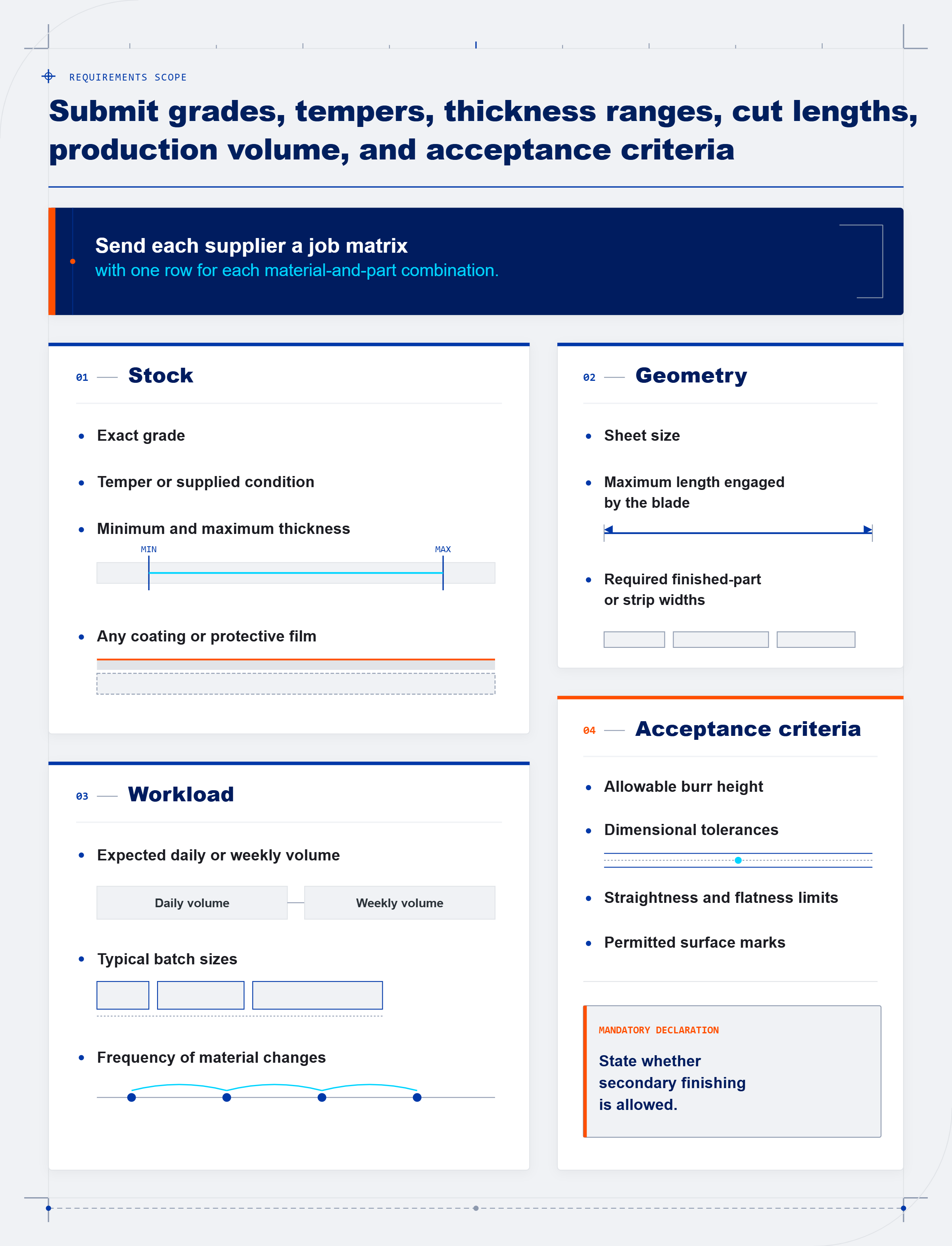
Send each supplier a job matrix with one row for each material-and-part combination. Include:
- Stock: exact grade, temper or supplied condition, minimum and maximum thickness, and any coating or protective film.
- Geometry: sheet size, maximum length engaged by the blade, and required finished-part or strip widths.
- Workload: expected daily or weekly volume, typical batch sizes, and frequency of material changes.
- Acceptance criteria: allowable burr height, dimensional tolerances, straightness and flatness limits, and permitted surface marks. State whether secondary finishing is allowed.
Attach relevant drawings and identify how each requirement will be inspected. Replace “good edge quality” with measurable limits or an agreed reference sample for appearance.
Obtain written capacity confirmation for the most demanding material-and-cut combinations
Ask the supplier to confirm the manufacturer-approved capacity for the proposed model against your job matrix. The confirmation should identify the approved tooling and any operating restrictions. Resolve missing approvals before scheduling cutting trials; a successful demonstration does not establish safe capacity.
Do not nominate only the thickest sheet as the test case. Maximum thickness, highest strength, and longest cut may occur on different jobs, so several combinations may need separate confirmation. Flag finish-sensitive work for quality trials as well: approval to cut it is not a guarantee that its surface will remain acceptable.
Confirm blade options, clearance adjustment, hold-downs, backgauge, and sheet support
Require the quotation to identify the equipment needed to meet your specification, including accessories that are not standard:
- Blades: manufacturer-approved blade options for every material group, plus any blade changes required between jobs.
- Clearance adjustment: sufficient range and a practical way to set and verify the gap between the blades. Obtain approved setup guidance, including rake—the blade angle—where adjustable.
- Hold-downs: clamps suitable for securing the specified stock before cutting, with an approved arrangement for sensitive surfaces.
- Backgauge: a positioning stop with the travel and repeatability needed for your dimensions. Confirm performance on finished parts during trials, not from the gauge specification alone.
- Sheet support: suitable support for incoming sheets and cut pieces, including the longest and most flexible stock.
Have the supplier demonstrate the required changeovers. Include blade changes, clearance adjustments, and support setup when assessing whether the machine can meet your production volume.
Require sample cuts checked for burrs, straightness, distortion, dimensions, and surface damage
Supply representative actual stock for the approved combinations. Cover the thickest, thinnest, strongest, longest-cut, and most finish-sensitive jobs where these impose distinct demands. Agree on the trial quantity and inspection methods before the demonstration rather than accepting a single handpicked cut.
Inspect the released parts for burrs, cut-edge straightness, bow or twist, finished dimensions, and surface damage. Record the stock identification, blade option, settings, and results so an acceptable setup can be reproduced. If secondary finishing is permitted, assess both its workload and the resulting part quality.
Require any corrective adjustments to remain within manufacturer-approved limits, then repeat the affected trial. Stop for unsafe cutting behavior; do not let attempts to improve appearance become an overload test. Unresolved failures should remain documented exceptions, not verbal promises of later improvement.
Check guarding, operator training, safe blade changes, service support, and replacement-blade costs
Before accepting the machine, confirm guarding, emergency stops, and operator training for the intended work. Obtain procedures for blade handling and changes, hazardous-energy isolation and lockout/tagout, securing moving components, and routine maintenance.
Request service coverage, response arrangements, spare-part availability, and replacement-blade prices and lead times. Ask for sharpening guidance for your stock mix, regrinding limits, and any setup work required afterward. These details establish what blade maintenance will cost and how it may interrupt production.
Buy only when written capacity approval covers your demanding jobs, actual-stock trials meet the agreed requirements, and safety and support provisions are satisfactory. If a required job remains outside those conditions, compare another shear or cutting process—or explicitly exclude that job from the purchase scope.