The Ultimate Punching and Shearing Machine Bible: A Transformation Guide from Cost Center to Profit Engine

Factory-sale Equipment
We have over 20 years in manufacturing. 
Press Brake
Laser Cutting Machine
Panel Bender
Hydraulic Shear
Get FREE Quote
Publish Date: October 31, 2025

I. What Is an Ironworker Machine?
1.1 Definition

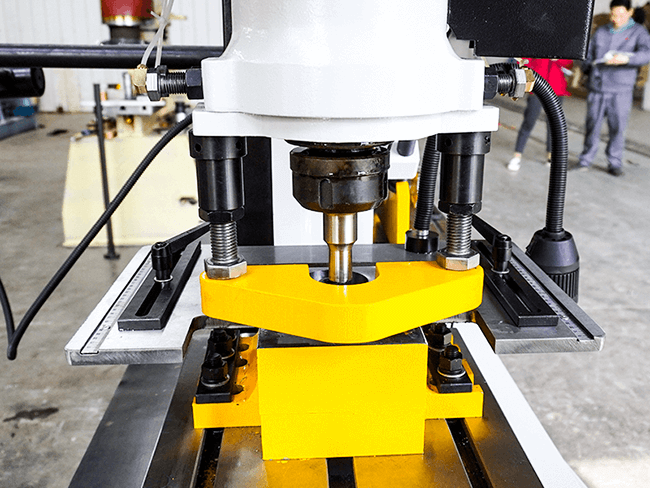
An ironworker is a versatile sheet metal fabrication machine capable of performing multiple operations on metal sheets, including cutting, bending, punching, and slotting. With interchangeable punches of various shapes, it can also process bars, rods, angles, and channels with precision.

Compared with other metal fabrication tools, an ironworker delivers cleaner cuts and smoother holes. Although its multifunctional nature and intricate build make it relatively large and heavy, ironworkers are available in a wide range of models—typically from 20 tons up to more than 200 tons in capacity.

Equipped with a dual-piston design, the machine can be operated by either one or two users. The operator can fine-tune the piston stroke distance to match the thickness of different metal materials, ensuring efficient and consistent performance.

1.2 The Value Equation: One Ironworker = Shear + Punch Press + Profile Cutter + N?

From a purely financial standpoint, an Ironworker’s worth far exceeds its purchase price. Its real value lies in what it replaces—the following powerful cost equation:

1 Ironworker ≥ 1 Plate Shear + 1 Punch Press + 1 Profile Cutter + 1 Notcher + N

Each term in this formula represents a tangible form of capital efficiency:

  • Reduced CapEx: The cost of one integrated system is far lower than the combined purchase price of four or five single-purpose machines.
  • Saved Floor Space: It consolidates multiple functions within the footprint of one machine—freeing up valuable factory space for storage, new production lines, or improved layout efficiency.
  • Lower OpEx: Maintaining a single hydraulic/electrical system is simpler and more economical than servicing several. Spare parts inventory, maintenance labor, and energy consumption all drop significantly.

But the most critical variable in that equation is the “+ N”—which stands for Strategic Agility. This intangible capability is what truly determines a company’s market resilience and competitiveness.

  • Opportunity Capture: When a customer requests a fast-turnaround sample or small-batch job involving multiple processes, you no longer have to decline due to procedural complexity. Your “microfactory” lets you confidently say, “Yes, we can.”
  • Risk Mitigation: When external subcontractors delay or underperform, your in-house versatility becomes your ultimate safety net—ensuring stability and quality in your supply chain.

Thus, buying an Ironworker isn’t merely a capital expenditure—it’s a strategic investment in responsiveness, flexibility, and long-term profitability.

IRONWORKER EFFICIENCY MATRIX

1.3 Core Advantages at a Glance: How the “Impossible Triangle” of Space, Cost, and Efficiency Was Broken

In traditional manufacturing, the relationship between space, cost, and efficiency often forms an “impossible triangle”: improving one usually worsens the others. The Ironworker’s integrated design philosophy defies this constraint, achieving simultaneous gains across all three dimensions.

Advantage DimensionTraditional Model: Multi-Station SetupIronworker Model: Integrated SystemBreakthrough Value
SpaceEquipment scattered across the floor; material flow is chaotic, with large areas wasted on aisles and waiting zones.Multiple operations vertically integrated into one compact platform, greatly increasing production density.Unlocks dormant factory value: repurposes non-productive space into profitable production or storage areas.
CostMultiple purchase costs, multiple maintenance systems, heavy internal logistics, and high energy use.Single-machine investment with centralized maintenance; lower energy and labor expenses.Achieves optimal Total Cost of Ownership (TCO): merges numerous “cost centers” into one productive asset.
EfficiencyProcesses fragmented by handling, waiting, and queuing; overall throughput is poor.Seamless process flow eliminates intermediate steps—enabling true single-piece, high-speed conversion from raw material to finished part.Redefines time value: converts wasted process time into real productivity and faster delivery, building a distinct competitive edge.

In essence, the Ironworker doesn’t just optimize an individual process—it reconfigures the very structure of production, transforming the cost-efficiency equation of metal fabrication. Rather than compromising within the “impossible triangle,” it transcends it through elevated, systems-level thinking.

1.4 Types

Beyond cutting, an ironworker machine can also be used for notching, bending, punching, and shaping tubes, bars, and steel sections. Its multifunctional capability greatly enhances production efficiency, making the ironworker an indispensable asset in metal fabrication.

Ironworkers generally fall into several categories, and the most suitable type depends on the specific demands and scale of the metalworking project.

Manual Ironworker

Manual ironworkers are the simplest models, operated entirely by hand. They are best suited for small-scale projects that require precision and control when working with lighter materials.

Capabilities:

  • Cutting: Suitable for thinner metal sheets and bars using manual force.
  • Punching: Effective for creating holes in metal sheets with hand-operated punches.
  • Notching: Ideal for making simple notches in metal pieces for assembly or welding.

Mechanical Ironworker

Mechanical ironworker machines use a mechanical linkage system to transfer energy from an electric motor to the tooling. They are efficient and have lower maintenance costs, making them suitable for lighter tasks.

Capabilities:

  • Cutting: Efficiently cut metal pieces, combining multiple functions into a single unit.
  • Punching: Capable of punching holes with precise mechanical force.
  • Notching: Suitable for basic notching tasks, providing reliable performance for lighter materials.
Mechanical lronworker

Hydraulic Ironworker

The hydraulic ironworkers operate using a hydraulic device that powers the movement of the machine's ram and blades. It comes in two types: single-cylinder and dual-cylinder operation. The hydraulic ironworker offers adjustable stroke and speed and has a flexible shaft movement.

The two-cylinder hydraulic ironworker features two independent hydraulic pistons that can be used for a range of operations, including punching, forming, shearing, and grooving. This piece of equipment is operated by a dual operator and has more complex functions compared to the one-cylinder operation in metal fabrication.

Capabilities:

  • Shearing: Can shear metal sheets, bars, and angles with precision and minimal effort.
  • Punching: Capable of punching holes in various shapes and sizes, even in thicker materials.
  • Notching: Equipped for precise notching operations, essential for metal fabrication.
  • Bending: Some models offer bending capabilities for forming specific angles and shapes.
Single-Operator Ironworkers
  • Compact and portable machines designed for smaller tasks or workshops with limited space.
  • Typically feature lower tonnage capacity but are efficient for simpler operations like punching or shearing.
Dual-Operator Ironworkers
  • Equipped with dual workstations that allow two operators to work simultaneously.
  • Ideal for larger fabrication shops where productivity is a priority.
  • Offer higher tonnage capacities and broader tooling options.

Multi-Station Ironworkers

  • Feature multiple workstations (up to five) for performing various operations like punching, shearing, notching, and bending without needing to switch tools frequently.

CNC or Automated Ironworkers

  • Include programmable controls for automated punching, shearing, or other operations.
  • Enhance precision and productivity in high-volume production settings.

1.5 Key Features

Robust Construction and Design:

  • Built with high-grade steel and precision engineering, ensuring durability and longevity under heavy use.

Force Generation and Capacity:

  • Hydraulic models use pressurized fluid for powerful and efficient operation.
  • Mechanical models rely on kinetic energy through gear and lever systems.

Operational Versatility:

  • Multiple workstations and quick-change tooling setups enhance productivity and reduce downtime.

Additional Capabilities:

Many models can be equipped with additional tools such as bar and rod shearing attachments, pipe coping tools, and press brake forming tools.

II. What Is an Ironworker Machine Used For?

 Ironworker

The ironworker machine is a versatile machine that is primarily used for cutting angles and shearing round and square bars, punching, grooving, and bending different metal plates, bars, and channels in various industries such as wind power generation, construction engineering, and mechanical equipment.

2.1 Primary Functions

Cutting

The cutting function ensures smooth edges and can be adjusted for various metal thicknesses by altering the piston stroke. This capability allows the machine to cut through bars, rods, angles, and channels efficiently.

Punching

The punches of an Ironworker can be used to punch pipes, angles, rods, flat bars, and more. The shape of the hole is determined by the shape of the punch, which can be round, square, or another shape.

Bending

Bending operations are another critical function of ironworker machines. They can bend metal sheets or form specific angles on iron bars, eliminating the need for additional bending or folding equipment.

Primary Functions of an lronworker

2.2 Secondary Functions

Shearing

The ironworker also has the ability to shear, including angle shearing and shearing flat bars. It can cut different types of bars, including flat bars, round and square bars optional, angle bars, and beams.

Notching

Notching is essential for shaping metal parts and components. Ironworker machines can notch various metal profiles, which is crucial for creating specific shapes and designs.

Forming Tubes and Bars

The ability to form tubes, bars, and other metal components makes ironworker machines valuable in a wide range of metal fabrication tasks. This function supports the creation of complex metal structures and designs.

The metal plates are held in place between the blades through hold-downs before being cut into the final profile. The ironworker is equipped with a special metal notching station, an adjustable rectangular unit, and a threading platform for performing V-shape and square grooving.

Although the bending capability of an ironworker may not be as precise as that of a press brake, it can still be used to bend some banisters, supports, and other low-accuracy requirement applications.

III. How Does an Ironworker Machine Work?

Ironworker machine

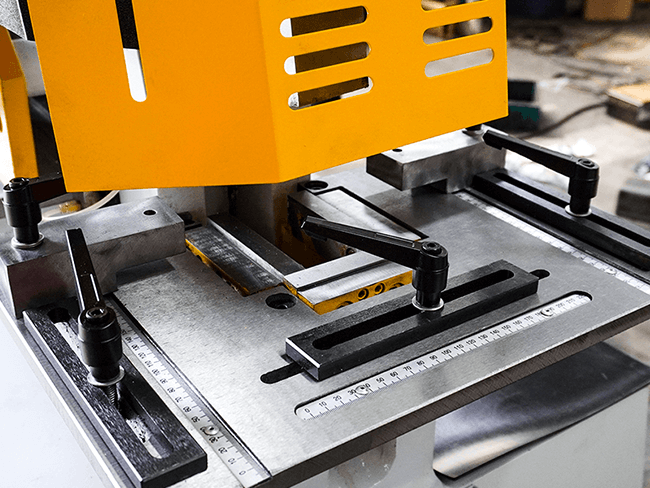
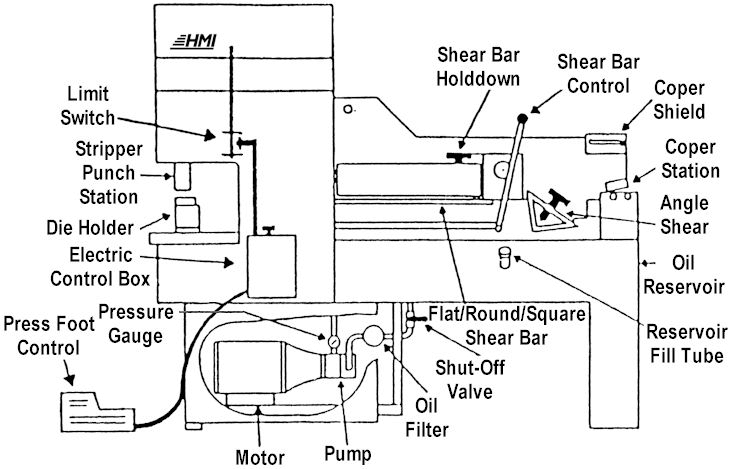
In addition to the integrated bending station, the Ironworker machine is a class of machines equipped with 5 different workstations and standard tools, allowing for separate punching, rebar shearing, sheet metal shearing, corner shearing, slotting, and more.

The Ironworker machine features multiple stations, including those for angle cutting, bar cutting, notching, shearing, and punching.

Each station is fitted with a hold-down device that ensures the material is accurately positioned and firmly secured. The machine operates through a power system that drives the ram-mounted blade to move vertically for shearing operations.

Every workstation contains corresponding upper and lower dies, typically made from diamond or similarly durable materials. The Ironworker machine delivers high efficiency and excellent cutting precision, capable of working with a wide range of materials such as angle iron, channel steel, square and round bars, flat steel, and flat angle steel.

In the hydraulic Ironworker model, the stroke and speed are controlled by a hydraulic cylinder, allowing for smooth and flexible motion of the shaft.

By contrast, the mechanical Ironworker uses a flywheel and crank mechanism to drive the blade or punch in an up-and-down motion.

IV. Ironworker Machine Accessory

 ironworker machine

The ironworker machine's frame serves as the body that holds the drive system, ram, and other components in place. It must be strong enough to prevent breakage or deformation during operation. The worktable is used to support the materials for cutting and notching and also as a location to fix the punching hole at the punching station.

The ironworker machine also features a "hold-down" clamping device near the shear blade to secure the shearing material and prevent movement. The hold-down can also be used to insert the material as a wedge between the upper and lower blades, increasing the gap.

The ironworker machine's blade, made of durable and sharp tool steel, is used for grooving and shearing. It is typically mounted on the ram and workbench at appropriate intervals, ensuring that the edge of the sheared workpiece is clean and smooth.

The ironworker machine's control device includes a control lever, control button, and foot pedal. Additional features, such as a CNC gauging device, hydraulic cooling system, custom tooling, light curtain, and guard fence, can also be included on the ironworker.
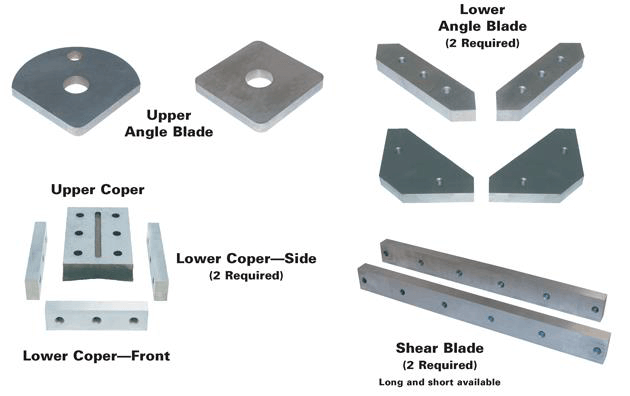
ironworker machine's blade

Ⅴ. Smart Decisions: A Three-Step Playbook for Choosing Your Ideal Ironworker

When faced with a sea of specs and price tags, selecting the right Ironworker is no longer a mere procurement task—it’s a strategic move that will shape your company’s competitiveness for years ahead. A misstep can mean idle capacity and wasted capital—or even lost market opportunities. The following three-step decision framework will help you cut through marketing noise, align investment with strategy, and ensure every dollar spent becomes a driver of sustainable profit growth.

5.1 Step One: Define Your Needs—Draw the Blueprint for Your Fabrication Future

Before evaluating any specific model, the first and most crucial task is to clearly and quantitatively define your actual production needs. This deep Needs Profile forms the foundation for all technical selections and financial analyses to follow—and the accuracy of this definition directly determines the success or failure of your investment.

5.1.1 Material Inventory and Thickness Boundaries: Define Your Core Battlefield

Take a sheet of paper or open a spreadsheet and carefully list all the materials you currently process — along with those you expect to handle in the next two to three years — and their respective thickness ranges. This step forms the foundation of your entire decision-making process. Different metals exhibit significant variations in shear strength, the single most critical factor determining the tonnage your equipment must deliver.

  • Primary Material List: Are you mainly working with Q235 mild steel, the ever-reliable baseline? Or do your operations involve tougher materials like 304 stainless steel? Perhaps you handle aluminum, copper, or other non-ferrous metals?
  • Defining Thickness Boundaries: Specify your thinnest, thickest, and most frequently processed thicknesses. The latter typically determines the machine’s optimal operating range.

Reference: Common Material Shear Strength Chart

Think of this chart as your manufacturing periodic table. It visually explains why cutting stainless steel of the same gauge requires substantially greater force than mild steel. Shear strength is usually expressed in megapascals (MPa).

Material TypeShear Strength (MPa) (Approx.)Relative Strength vs. Mild SteelProcessing Characteristics & Notes
Mild Steel (Q235)3451.0 (Baseline)The most common material for fabrication; serves as the baseline for tonnage calculations.
Medium/High Carbon Steel (e.g., 45#)550+1.6+Increased hardness and brittleness; requires higher tonnage and more wear-resistant tooling. Monitor for crack formation.
Stainless Steel (304 / 316)517+~1.5High strength with significant work-hardening tendency; allow an extra 20–30% tonnage margin in calculations.
Aluminum Alloy (6061-T6)207~0.6Low strength, easy shearing; soft material can cause burrs and tool adhesion—ensure clean cuts.
Copper220~0.65Soft and easy to process; high thermal and electrical conductivity require attention to die heating during high-speed operations.
Titanium Alloy550–800+1.6–2.3+Extremely strong and elastic; machining difficulty is high, demanding exceptional rigidity, power, and die materials.

Insight Upgrade: A material’s shear strength is not an absolute value. It varies significantly depending on its heat-treatment condition (e.g., annealed, solution-treated, aged) and specific alloy grade. For accurate tonnage calculations, never rely solely on rough estimates—always consult the material’s Technical Data Sheet (TDS) for precise parameters.

5.1.2 Production Capacity and Efficiency Bottlenecks: Calculate Your Required Hourly Output

Avoid the trap of thinking “faster is always better.” What you truly need is capacity aligned with your business scale — sustainable and practical. Express your efficiency goals in measurable terms such as Parts Per Hour (PPH).

  • Target Capacity Calculation: Examine your order mix — are you dealing with high-volume, single-type production or small batches across multiple varieties? Quantify your weekly or daily workload: number of parts, holes punched, or meters sheared.
  • Diagnosing Current Bottlenecks: Investigate what’s slowing you down. Is it the excessive movement of workpieces between the punch press and shear? Or frequent manual layout and alignment? A combined punch-shear system is designed precisely to eliminate these hidden “time black holes.”

Expert Tip: The machine’s theoretical strokes per minute (SPM) figure is a lab benchmark—not your real-world productivity. Actual throughput (PPH) is shaped by feed rate, positioning method, tool-change time, programming efficiency, and operator skill. Your goal is to choose a system that converts the highest possible proportion of theoretical SPM into practical production.

5.1.3 Precision Demands and Budget Limits: Find the Perfect Balance Between ‘Good Enough’ and ‘High Performance’

Precision and budget represent the eternal trade-off in equipment decision-making. Chasing levels of accuracy far beyond your needs can multiply costs for both machines and tooling, while insufficient precision inevitably leads to waste and dissatisfied clients.

  • Define “Just-Right” Precision: Review your engineering drawings and pinpoint the tightest tolerance requirement. Are you working with structural steel components that allow ±0.5 mm deviation, or precision enclosures demanding ±0.1 mm accuracy? This will determine whether manual stops, CNC backgauges, or servo-controlled positioning are most appropriate.
  • Set a Clear Total Investment Cap: Establish your absolute spending ceiling. Remember—it should encompass not only the machine’s purchase price but also tooling, transport, installation, calibration, operator training, and initial spare parts. These auxiliary costs typically account for 10–25% of the machine’s base price.

Decision Wisdom: When funds are limited, avoid buying an all-purpose machine that performs acceptably in everything but excels in nothing. Instead, adopt a focused investment strategy—purchase a machine that delivers exceptional precision for your core process (e.g., punching), and handle lower-precision operations (e.g., corner cutting) through simpler methods. This targeted approach provides smarter, long-term cost control.

5.2 Step Two: Machine Matching—Decoding the Power, Structure, and Tonnage Matrix

Once your needs are clearly mapped, you can begin selecting equipment with precision. Understanding how different machines vary in their power source, structural design, and tonnage calculations is essential to making sound choices.

5.2.1 Comparing Power Systems: Hydraulic vs. Mechanical — Which Engine Suits You Best?

Punching and shearing machines fall into two major categories—hydraulic and mechanical—with servo direct-drive emerging as a powerful new contender. Much like engines in cars, each system has distinct characteristics and performs best under specific operating conditions.

Reference: Comparative Decision Matrix for Power Systems

FeatureMechanicalHydraulicServo-Direct Drive
Working PrincipleEnergy is stored in a flywheel and transmitted through a crank and connecting rod; stroke is fixed.A hydraulic pump drives cylinders via control valves; pressure output remains constant.A servo motor drives the ram directly; its motion curve is fully programmable.
Pressure CharacteristicsMaximum pressure occurs only at bottom dead center; pressure varies along the stroke and cannot be adjusted.Delivers constant pressure throughout the stroke; both pressure and stroke are precisely adjustable—ideal for deep drawing or embossing.Real-time controllability across the entire stroke; speed and pressure at any point can be programmed freely.
Stroke and SpeedFixed stroke with high speed—best for high-volume, repetitive production.Adjustable stroke, slower speed, but supports “work feed–quick return” flexibility.Extremely flexible—speed, stroke, and even dwell time can be fully programmed to match complex processes perfectly.
FlexibilityLimited—retooling for different die heights is cumbersome; narrow process adaptability.Excellent—handles multiple materials and processes (punching, shearing, bending) with ease.Optimal—multiple motion modes (stamping, pressing, oscillating, etc.) achievable via software control.
Overload ProtectionRigid system—overload can easily lead to catastrophic damage such as crankshaft breakage.Built-in safety—relief valves automatically release pressure, protecting both the machine and the tooling.Electronic overload protection—monitors motor current for millisecond-level response with high precision.
Cost & EnergyLower initial investment and maintenance, but high energy consumption (flywheel runs continuously).Mid-level initial investment; hydraulic maintenance is demanding; standby power consumption persists.Highest upfront cost, but superior energy efficiency (power consumed only during working stroke); lowest long-term operating cost.
Decision GuideBest for single product types, high-volume, high-speed blanking or shallow forming.Best for multi-product, small-to-medium batches, thick materials, or applications requiring pressure holding or stroke control.Best for high-value, complex forming, high precision, and ultra-flexible, energy-efficient smart factories.

Lesser-known fact: Overload protection is one of the most underrated advantages of hydraulic punching and shearing machines. It lets you push boundaries—processing at near material limits—without fear of catastrophic failure. If a die jams unexpectedly, the relief valve opens to protect expensive tooling and key components. On a mechanical press, a single severe overload could cost up to 30% of the machine’s total value in repairs.

5.2.2 Structure and Workstations: From Combined Ironworkers to CNC Servo Systems—Understanding Application Scenarios by Configuration

  • Combined Ironworker: Think of this as the “Swiss Army knife” of metal fabrication. Its classic configuration typically includes punching, flat bar shearing, angle/round/square bar cutting, and notching—four to five independent stations. Its greatest value lies in process integration, making it ideal for steel structures, transmission towers, repair workshops, and small-batch, high-variety production.
  • Single-Head / C-Frame Press: Featuring an open (C-shaped) frame that provides ample working space and easy material handling, it is the core equipment for coil or sheet feeding automation lines.
  • H-Frame / Straight-Side Press: With a closed-frame (H-type or portal structure) and superior rigidity, it can withstand enormous tonnage and eccentric loads. It is the go-to choice for automotive body panels, thick plate fine blanking, and other high-precision heavy-duty forming applications.
  • CNC Turret Punch Press: Equipped with a rotating turret holding dozens of tools, this machine uses CNC control to punch complex holes and contours rapidly on sheet metal. It embodies the concept of flexible manufacturing in modern sheet metal processing.

5.2.3 Calculating Tonnage Scientifically: Replace Guesswork with Formulas for Accurate Punching and Shearing Force Estimation

Selecting too small a tonnage means the machine cannot handle the job; choosing one that’s too large leads to wasted capital and energy. Use the following well-established engineering formulas for precise calculation.

1. Punching / Blanking Force Formula:

P (ton) = [ (L × T × Sₛ) / (1000 × 9.8) ] × K

  • P: Required punching force (metric tons)
  • L: Total perimeter of the punched contour (mm). Example: punching a 20 mm-diameter hole → L = 20 × π ≈ 62.8 mm.
  • T: Material thickness (mm).
  • Ss: Material shear strength (MPa) — refer to the table in section 2.1.1.
  • K: Safety factor, a critical parameter typically set at 1.3 to compensate for material strength variation, tooling wear, or poor lubrication.

Example Calculation: Punch a 30 mm-diameter hole in a 10 mm-thick Q235 low-carbon steel plate (shear strength = 345 MPa).

  • L = 30 mm × 3.14159 = 94.25 mm
  • P = (94.25 × 10 × 345) / 9800 × 1.3 = 43.1 tons
    Therefore, you need a press rated for at least 43.1 tons.
Punching Force Calculation

2. Shearing Force Formula:

Calculating shearing force differs slightly because the upper blade of a shear typically has an inclination angle.

P (ton) = [ (0.5 × T² × Sₛ) / tan(α) ] × [ K / 9800 ]

For most ironworkers’ flat-bar shearing stations, this can be simplified as: shearing force ≈ 0.6–0.8 × (plate thickness × shear length × shear strength). However, the most reliable method is to refer to the machine manufacturer’s “shearing capacity chart.”

Insider Tip: Using a sheared punch/die (angled cutting edge) is a powerful technique to significantly reduce punching tonnage requirements. By grinding a slight tilt—typically equal to or slightly larger than the material thickness—onto the punch or die edge, the cutting process changes from an instantaneous impact to a progressive shear, like a pair of scissors. A well-designed shear angle can lower punching and shearing force needs by 30–50%, reducing vibration and noise while extending tool life—an invaluable advantage in borderline tonnage situations.

5.3 Step Three: Investment Evaluation—Building Your Full Life-Cycle ROI Model

A punching and shearing machine is not a consumer product but a productive asset. Top-tier decision-makers focus far beyond the purchase price—they care about the Return on Investment (ROI) over the machine’s entire service life.

5.3.1 Cost Structure Breakdown: A Full-Spectrum View from Purchase Price to Hidden Maintenance Expenses

To calculate the real investment cost, the concept of Total Cost of Ownership (TCO) must be introduced.

  • Visible Costs (Above the Iceberg):
    • Equipment Purchase Price: The main unit and standard accessories.
    • Optional Accessories and Tooling: Additional specialized tools (e.g., louver or bending dies), automatic feeders, and similar items—these costs can be significant.
    • Infrastructure and Installation: Foundation preparation (especially for high-tonnage presses), equipment hoisting, power setup, compressed air supply, and related work.
    • Freight, Insurance, and Customs Duties: A major cost factor that must be included, particularly for imported equipment.
  • Hidden Costs (Below the Iceberg—and More Critical):
    • Energy Consumption: Energy efficiency varies greatly across drive systems. The energy savings of a servo model can offset its higher purchase price within 3–5 years.
    • Maintenance and Spare Parts: Regular replacement of hydraulic oil, filters, and seals; wear on clutch and brake pads in mechanical presses; sharpening and replacement of cutting tools.
    • Operator Training: The time and financial investment differ dramatically between manual operation and CNC programming.
    • Downtime Losses: Production interruptions due to equipment failures are among the costliest and most unpredictable components. Choosing a reliable brand with responsive after-sales service is, in effect, buying insurance against such losses.

5.3.2 Quantifying Returns: How to Calculate Savings in Labor, Materials, and Outsourcing Costs

The benefits of investing in new equipment must be quantified to enable a fair comparison against costs.

  • Labor Cost Savings: This is the most direct gain. When three separate operations (punching, shearing, material handling) are integrated into one combined machine operated by a single person, the annual wages, benefits, and management overhead for two workers can be saved.
    • Annual Labor Savings = (Number of Workers Saved) × (Average Annual Cost per Worker)
  • Material Cost Savings: With optimized nesting (especially via CNC systems) and a significantly lower scrap rate, you can accurately calculate the monthly raw material savings.
    • Annual Material Savings = (Previous Scrap Rate - Current Scrap Rate) × (Annual Material Purchase Value)
  • Elimination of Outsourcing Costs: Bringing previously outsourced punching or cutting processes in-house not only saves outsourcing fees but also keeps profit internal and strengthens control over both quality and delivery times.
  • Opportunity Gains from Increased Efficiency: Reducing a production cycle from three days to half a day means you can take on more urgent orders and respond to market changes faster. Although this “agility premium” is hard to measure precisely, it directly enhances your competitive edge.

5.3.3 Payback Period Forecast: Decision Support Based on the 18–36 Month Industry Benchmark

The Payback Period is the most straightforward indicator for assessing an investment’s attractiveness.

Simplified Calculation Formula:

$ \text{Payback Period (months)} = \frac{\text{Total Investment Cost (TCO)}}{\text{Monthly Net Return (Monthly Total Benefit − Additional Monthly Operating Cost)}} $

  • Industry Benchmark: For most small and medium-sized manufacturers, a sound equipment investment typically pays back within 18 to 36 months. If your result far exceeds three years, reconsider—was the requirement misdefined, or is the chosen model over-specified? Conversely, a payback shorter than 18 months signals a remarkably strong investment opportunity.
  • Let the Data Speak: Populate a table with all quantified costs and returns—let the numbers guide your decision rationally. A comprehensive ROI report like this becomes your most persuasive tool when presenting a budget request to management or finance.

Through this rigorous, systematic analysis, you can evolve from a regular machine operator into a strategic investor. What you choose will no longer be a cold piece of equipment but a powerful engine that continuously creates value and drives business growth.

Ⅵ. Foundational Mastery: Seven Key Dimensions from Startup to Precision Finishing (Core Practices)

If the first two chapters were about charting the blueprint and choosing your warhorse, this chapter takes you onto the battlefield—where you turn theory into productive mastery. A top-tier machine has 90% of its potential sealed within the operator’s hands and mind. The following four foundational dimensions are your first step in unlocking that potential, transforming “ability to operate” into “true expertise.” Together, they form the practical cornerstone for precision cutting and punching.

6.1 Dimension One: Precision Control—The Art of Achieving ±0.1 mm Tolerance

In the metalworking value chain, precision is the sole standard separating a craftsman from a laborer. Achieving and consistently maintaining a ±0.1 mm or finer tolerance is not mysticism but a rigorous science grounded in physical principles. It requires mastery over three seemingly minor yet critically impactful variables.

6.1.1 The Magic of Die Clearance: Optimal Setup for Different Sheet Thicknesses

The soul of punching and shearing lies in die clearance—the single-sided gap between the punch and die. Though measured in microns, this minute space acts as an invisible conductor orchestrating the quality of the cut surface, burr formation, shearing force, and tool longevity.

  • Clearance Too Small: The material is compressed, causing double shearing lines on the cut surface. Cutting force soars, and the die wears rapidly—as if it were fighting itself.
  • Clearance Too Large: The material is torn rather than sheared, resulting in severe roll-over and heavy burrs. Part accuracy and surface finish deteriorate sharply.

Core Principle: Die clearance is typically set as a percentage of material thickness. The ideal gap allows cracks originating from the upper and lower edges to meet perfectly about one-third through the material thickness, producing a smooth, bright cut face.

Reference Table: Optimal Die Clearance Settings (Total Clearance) for Different Materials

Material TypeOptimal Total Clearance (% of Material Thickness)Expert Insight and Processing Strategy
Aluminum (Soft)10%Soft and highly ductile — use a smaller clearance to achieve a clean, tear-free edge.
Brass / Copper12% - 15%Falls between aluminum and steel in behavior; tolerance for clearance variation is wider.
Low-Carbon Steel (Q235)15% - 20%The industry baseline for general-purpose steels. Use smaller values for thin sheets and larger for thicker plates.
Medium / High-Carbon Steel20% - 22%Harder and more brittle materials require a larger clearance to reduce shearing impact and avoid chipping.
Stainless Steel (304 / 316)22% - 25%Challenging to process! Extremely tough and prone to work hardening — needs larger clearance and high-toughness tooling (e.g., coated high-speed steel). Insufficient clearance is the leading cause of premature die failure.

Mindset Shift: The optimal clearance is not a fixed absolute value. When using a worn or passivated die, increase the clearance by 1–2% to offset the rounded cutting edge. For high-precision blanking applications, clearance adjustments may need to reach the 0.005 mm level of accuracy.

6.1.2 Alignment System Calibration: Precision Use of Backgauge and Scribed-Line Positioning

If clearance determines the quality of the cut, then the alignment system determines the quantity — the accuracy of your dimensions.

  • Backgauge Calibration: The backbone of consistency in batch production.
    1. Reference Calibration: Regularly use precision gauge blocks or dial calipers to physically move the backgauge to a known position relative to the blade or punch center (e.g., 100.00 mm).
    2. System Compensation: Enter the difference between the measured and displayed values into the CNC system to complete the software calibration.
    3. Parallelism Verification: Using a magnetic base and dial indicator, check the backgauge bar’s parallelism to the blade across its full length. Any deviation will inevitably cause tapered cuts on long material.
  • The Art of Scribed-Line Positioning: For single pieces or irregular shapes, scribed-line alignment remains the most efficient positioning method.
    • Technique: Never rely on visual estimation. Use the machine’s jog function to slowly lower the punch tip or blade edge until its shadow perfectly aligns with the scribed line — or use a line light’s crosshair to pinpoint alignment. This simple step can improve manual positioning accuracy by an order of magnitude.

6.1.3 Hold-Down Optimization: The Key to Preventing Material Distortion

During the instant of shearing, immense impact forces try to move or warp the material. The hold-down mechanism (also known as the clamp foot) is the “iron hand” that keeps this force under control.

  • Pressure Adjustment: For hydraulically driven hold-downs, adjust pressure based on material thickness and strength. The rule: apply the maximum clamping force possible without leaving surface marks on the sheet.
  • Challenges with Thin or Narrow Stock: The most deformation-prone scenarios.
    • Problem: Narrow workpieces may cause some hold-down feet to hang off the material, creating uneven pressure and bending or twisting during shearing.
    • Solution: Use spacers matching the workpiece width beneath any unsupported hold-down foot. Ensuring all feet press evenly on a single plane is the surest way to maintain straight cuts on narrow stock.

6.2 Dimension Two: Material Adaptability — Mastering the “Temperament” of Metals

Treating all metals the same is a beginner’s mistake. Each type has its own temperament — its unique mechanical behavior. Only by working with these traits can you achieve optimal results.

6.2.1 Hardness and Toughness: Processing Traits and Strategies for Common Metals (Carbon Steel, Stainless Steel, Aluminum)

  • Low-Carbon Steel (Q235): “The Gentle Partner.” With moderate hardness and good toughness, it processes easily and serves as the ideal reference for evaluating both equipment and operator performance.
  • Stainless Steel (304): “The Tenacious Opponent.” Two defining characteristics: high toughness and work hardening. Under stress, it hardens rapidly — attempting to process it with standard dies is like striking a rock with an egg.
    • Strategy: (1) Use a press with 30% or more extra tonnage beyond the calculated requirement; (2) choose tooling specifically designed for stainless steel, offering high wear and impact resistance (e.g., cobalt high-speed steel or TiCN-coated dies); (3) never use dull tooling — doing so guarantees chipped edges and scrapped parts.
  • Aluminum Alloy (6061): “The Sticky Sprite.” Characterized by softness and stickiness, it tends to form built-up edges on the tooling, degrading cut quality and marring subsequent parts.
    • Strategy: (1) Use smaller tool clearance; (2) choose dies with highly polished surfaces; (3) apply specialized punching and shearing lubricants to create a separating film that prevents adhesion.

6.2.2 Burr and Crack Control: Preventive Measures for Brittle and Ductile Materials

  • Burr Control: Burr height is the most visible indicator of shearing quality.
    • Root Cause: 90% of burr issues stem from two factors — improper clearance and dull cutting edges.
    • Solution: Strictly follow the clearance table from section 3.1.1 and implement a regular die sharpening schedule. A sharp tool saves far more in post-deburring labor costs than its sharpening expense.
  • Crack Control: Cracks typically appear around punched edges or bending areas.
    • Root Cause: Insufficient ductility (as in high-carbon steel) or holes placed too close to edges or other holes (maintain a safety margin at least twice the sheet thickness).
    • Solution: For brittle materials, avoid punching near edges; increase hole spacing and edge margins where possible; ensure punch and die are perfectly aligned to prevent excessive one-sided loading.
Burr Control

6.2.3 [Avoidance Guide] Processing Danger Zones — Conditions That Destroy Tools and Equipment

Treat the following rules as absolute red lines — violating any could cost thousands, even tens of thousands, in damage.

  • Absolutely Forbidden: Never attempt to process hardened steels, spring steels, or bearing steels — anything that has been heat-treated. Their hardness often exceeds that of your tooling, leading to catastrophic failure.
  • No Stacked Cutting: Never shear or punch two or more thin sheets at once. It destroys accuracy and subjects the die to uneven side forces, resulting in damage.
  • Beware of Welds and Laminations: Avoid shearing in heat-affected zones or across weld seams. These areas have wildly inconsistent structures and hardness — like hidden landmines ready to chip your tooling.
  • Lateral force is the enemy: Unless you're using a specially designed trimming die, never attempt to punch a “half-hole” or cut angles along the sheet edge. Excessive lateral force can snap your punch like a twig.
  • Test unknown materials first: Before machining any material unfamiliar to you, test a small scrap piece to assess its hardness and machining response.

6.3 Dimension Three: Efficient Operation—Optimizing Rhythm Under Standard Procedures

True efficiency doesn’t come from frantic speed—it comes from consistency and precision within standardized procedures. By systemizing best practices and unlocking equipment potential, you can easily improve production rhythm by more than 20%.

6.3.1 Pre-Startup Safety Checklist: 12 Critical Points You Must Not Overlook

Build this one-minute routine into muscle memory—it can help you avoid 90% of unplanned shutdowns and safety incidents.

  1. [Environment] Ensure protective systems (light curtains, safety doors) are functioning properly and not bypassed.
  2. [Environment] Check that the footswitch is securely positioned and safe from accidental activation.
  3. [Hydraulic] Visually check hydraulic oil level—it should be above the midpoint on the gauge.
  4. [Electrical] Confirm that the emergency stop button has been reset and no alarms appear on the control panel.
  5. [Tooling] Visually inspect upper and lower dies/blades to ensure they are securely fastened with no looseness.
  6. [Tooling] Gently touch the blade edge to confirm there are no chips or rollovers.
  7. [Lubrication] Check oil levels in the automatic lubrication system, or manually oil key parts such as guide rails and sliders.
  8. [Positioning] Manually move the back gauge to ensure smooth, unobstructed travel throughout its range.
  9. [Clamping] Run a dry cycle to confirm smooth and firm clamping foot motion.
  10. [Pneumatics] If equipped with a pneumatic system, verify that air pressure meets equipment requirements.
  11. [Personal] Wear your safety glasses—this is a non-negotiable rule.
  12. [Work Area] Ensure no tools, gauges, or debris remain on the worktable or die area.

6.3.2 Batch Layout Techniques: The Secret to Achieving Over 85% Material Utilization

In many factories, raw material costs account for more than 50% of total expenses. Improving material utilization by even 1% translates directly into a significant increase in net profit.

  • Interleaved nesting: Rotate or mirror asymmetric parts 180° so their contours fit tightly together like puzzle pieces.
  • Common-edge cutting: Design adjacent parts to share a cutting edge—an extremely effective way to reduce scrap.
  • Scrap reuse: After punching large holes, use the leftover discs or sizable offcuts to nest smaller parts—achieving “one material, two uses.”
  • Software optimization: Ditch manual estimation! Use professional nesting software—its algorithms can generate thousands of layout options within seconds, easily raising material utilization from the traditional 60–70% to over 85%. The cost savings usually offset software investment within just a few months.

6.3.3 [Special Technique] Stroke Control Applications: For Countersinks, Shallow Embossing, and Other Advanced Processes

This is the true “superpower” of hydraulic or servo-driven punching machines compared with conventional mechanical equipment. By precisely controlling the slide’s bottom-dead center, you can transform your punch press from a mere cutting tool into a versatile forming platform.

  • Countersinking: Fit a countersink punch and program the press depth so the punch penetrates only partway into the material, producing standard and countersunk holes in a single operation—eliminating secondary drilling or milling steps.
  • Shallow embossing/marking: With stroke control and custom dies featuring logos or characters, you can create precise permanent marks or reinforcing ribs (e.g., 0.2 mm deep) far more efficiently and consistently than manual stamping.
  • Press-fitting/riveting: Using slow, precise pressure and displacement control, you can press PEM nuts, studs, or bearings smoothly into the sheet, enabling assembly functions and turning the punch press into a simple pressure machine.

6.4 Dimension Four: Safety Foundation—Building a “Zero-Accident” Operational Culture

A punch press is powerful enough to shear through thick steel instantly. Any disregard for safety can cause irreversible consequences. Zero accidents isn’t a goal—it’s a mandatory standard.

6.4.1 Identifying and Physically Securing the Three High-Risk Zones

  1. Point of Operation: The tooling work area is the most hazardous zone. It must be safeguarded using fixed shields, dual-hand control buttons, or safety light curtains, ensuring it’s physically impossible for any part of the operator’s body to enter while the slide is in motion.
  2. Power Transmission Area: Includes flywheels, belts, gears, and linkages. These must be fully enclosed with rigid guards to prevent loose clothing, long hair, or cleaning rags from being drawn in.
  3. Material Swing and Ejection Zone: Long stock may swing rapidly during shearing, and small scraps can eject at high speed. Use yellow floor markings or movable physical barriers to define safe boundaries and restrict access for non-operating personnel.

6.4.2 Personal Protective Equipment (PPE) Checklist and Proper Usage

PPE is your final—and closest—line of defense.

  • Safety glasses: Must be worn at all times! Even if you’re just passing through the area, wear them. They’re the most effective protection against flying metal chips or debris.
  • Cut-resistant gloves: Wear only when handling sharp sheets or changing dies. During machine operation, never wear any gloves, as moving components can catch them and cause far more severe injury than simple cuts.
  • Steel-toe safety shoes: They must protect against impact (to shield toes from falling objects) and puncture (from sharp floor debris).
  • Earplugs/Earmuffs: In high-noise environments or during extended punching operations, wear them to prevent permanent hearing loss.
Ironworker Machine

6.4.3 Preventive Measures for Common Hazards (e.g., Small Part Ejection)

  • Hazard Description: When punching small or narrow strips, the cut-off pieces can shoot out like shrapnel under punch force, posing a serious injury risk.
  • Preventive Measures:
    1. Use high-strength polyurethane ejectors: Install powerful polyurethane or nitrogen springs within the lower die to firmly lift or gently eject cut pieces in a controlled direction.
    2. Install transparent safety shields: Mount heavy polycarbonate (PC) protective covers around the die area to physically block any flying debris.
  1. Optimize Die Design: Incorporate return pins or design the die with a negative clearance “clamping” structure. This ensures that the part remains temporarily secured within the die after punching, rather than being ejected uncontrollably.
  2. Adjust Processing Sequence: When cutting multiple parts from one sheet, prioritize smaller parts earlier in the workflow or optimize the cutting path so that during the final cut, the part still maintains sufficient connection with the base sheet to stay stable.

Ⅶ. Performance Leap: Advanced Strategies to Unlock a 40% Efficiency Boost

Once the basics are mastered, true competitive advantage lies in maximizing operational efficiency and planning ahead. You may already be delivering consistent, qualified parts—but your equipment likely holds more than 40% untapped potential. This chapter introduces three advanced strategies: preventive maintenance, lean process optimization, and automation integration. Together, they bridge the present and the future—helping transform your punching machine from a mere production tool into the metronome that drives your workshop’s rhythm and doubles profitability.

7.1 Dimension Five: Maintenance—The Preventive Secrets That Extend Equipment Life by 30%

The most expensive repair is always the unexpected shutdown. The real losses stem not from replacement costs but from halted production, delayed orders, and eroded customer trust. Preventive maintenance is smart management—it uses minimal cost to avoid maximum losses. It isn’t an expense; it’s a high-return investment. A well-structured maintenance plan can extend equipment life by over 30% and serves as the cornerstone of stable production and precision assurance.

7.1.1 Preventive Maintenance Schedule: Daily, Weekly, and Monthly Task Template

Don’t leave your equipment manual collecting dust. Use this template as a guide and customize it according to your specific machine manual. Print, laminate, and post it next to the machine to establish it as an unbreakable rule on the shop floor.

CycleTask ListCore Purpose
Daily1. Cleaning: Remove waste, oil, and debris from around the equipment, workbench, and die surfaces.
2. Lubrication: Inspect and replenish all manual lubrication points (e.g., guideways, lead screws) with oil or grease as needed.
3. Air System Check: Drain condensate from pneumatic units (especially balance cylinders) and verify air pressure.
4. Safety Devices: Perform idle tests on emergency stop buttons, safety light curtains, and door interlocks.
5. Auditory Check: Listen carefully during operation for any unusual noises or vibrations.
Maintain daily safety and stability: Detect and resolve issues in their early stages to ensure safe daily operation and prevent minor defects from escalating into major failures.
Weekly1. Fastener Check: Systematically inspect and tighten bolts on the frame, motor, back gauge, and die plates.
2. Hydraulic System: Check oil level and color, ensuring no leaks at hose connections.
3. Balance Cylinder: Use a pressure gauge to confirm pressure within recommended range—incorrect pressure accelerates wear on the main drive.
4. Electrical Cabinet Cooling: Clean dust from ventilation filters to maintain proper heat dissipation.
5. Tool Inspection: Remove tools and examine edges for chips or rolls.
Prevent cascading failures: Address loose components, abnormal pressure, and overheating before they lead to major breakdowns—key to ensuring long-term stable operation.
Monthly1. Guideway Precision: Clean and reapply grease on slider guideways; check clearance with a feeler gauge to ensure tolerance compliance.
2. Hydraulic Oil Filter: Replace or clean filters based on contamination indicator or service time.
3. Clutch/Brake: On mechanical presses, check wear and clearance of friction discs.
4. Transmission System: Verify belt and chain tension for smooth power delivery.
5. Oil Sampling: Take a small sample of hydraulic oil to assess clarity and contamination.
Preserve core accuracy and performance: Deep maintenance for key motion and power components directly enhances machining precision and extends equipment life.

7.1.2 Tool and Die Life Management: Five Core Techniques from Sharpening to Storage

Dies are consumables, but they’re also high-value assets. A mold worth a few thousand yuan can easily generate double that value when properly managed and maintained.

  1. Establish Sharpening Standards Instead of Waiting for Damage: When burrs on parts increase noticeably or punching sounds become dull, it has reached the sharpening threshold. At this point, removing only 0.1–0.2 mm is sufficient. Waiting until the edge chips may require removing more than 1 mm, drastically shortening the die’s overall lifespan.
  2. Proper Lubrication, Not ‘Dry Grinding’: The main purpose of punch lubrication is cooling and preventing adhesion, followed by actual lubrication. When processing stainless steel or aluminum, use volatile stamping oils specifically formulated for punching rather than standard machine oil. This minimizes built-up edges, extends die life, and improves cut quality.
  3. Standardized Storage to Prevent Secondary Damage: Assign each die set to a dedicated, labeled storage rack. After sharpening, coat with rust-preventive oil and store vertically or horizontally with cutting edges facing inward. Never stack molds randomly—this can cause edge chipping or deformation.
  4. Create Usage Records for Predictive Management: Develop an “ID card” for each critical die, logging purchase date, cumulative strokes, sharpening history, and maintenance records. These data provide insight into its life expectancy, enabling timely spare part procurement and preventing downtime due to unexpected tool failure.
  5. Empower Operators with ‘Mold Protection Rights’: Train operators to understand each die’s load limits and correct usage. Authorize and encourage them to stop the machine immediately upon noticing irregularities (such as sudden pressure spikes) rather than pushing through. This mindset forms the most effective firewall for mold protection.

7.1.3 Common Faults Quick Diagnosis Tree: Five-Step Troubleshooting for Hydraulic, Electrical, and Mechanical Issues

When the machine alarms or stops, chaotic troubleshooting wastes time and can exacerbate failures. Following a clear diagnostic tree allows you to pinpoint 80% of common issues within 5–10 minutes.

Step 1: Read the Alarm—Translate the Machine’s Language

  • What does the control panel display? “Overload,” “Emergency Stop,” “Servo Fault,” or an I/O error code? These are the machine’s direct messages—capture them with a photo for documentation.

Step 2: Identify Fault Type and Narrow Down the Scope

  • Hydraulic Fault Indicators: Weak or sluggish ram movement, unusual rise in oil temperature, or a sharp “screeching” noise from the pump (possibly due to air intake).
  • Electrical Fault Indicators: Machine won’t start, control panel or buttons unresponsive, sensor lights off, motor not running despite no mechanical obstruction.
  • Mechanical Fault Indicators: Sudden precision drop, cracks or breakage in components, rhythmic knocking during motion, or jamming at specific positions.

Step 3: Conduct Safe Checks from Outside to Inside

  • Hydraulic Issues: 1. Check the oil level and temperature gauge. 2. Verify that the pressure gauge readings are within the normal range. 3. Listen for any unusual noises from the hydraulic pump and inspect the suction line for air leaks.
  • Electrical Issues: 1. Ensure all emergency stop buttons (including those on foot switches) have been reset. 2. Check whether the safety door or light curtain has been triggered or obscured by dirt. 3. Open the electrical cabinet and see if any circuit breakers have tripped. 4. Observe the I/O indicator lights on the PLC to confirm that sensor signals are being properly received.
  • Mechanical Issues: 1. Verify that the mold is properly installed and firmly secured. 2. Check for scrap material or foreign objects caught in moving parts. 3. Confirm that lubrication is adequate.

Step 4: Isolate the Issue—Perform Single-Point Testing

  • In manual mode, try operating a single movement (such as advancing the back gauge or inching the slide) and observe the response. This helps determine whether the fault is system-wide or localized to an individual actuator.

Step 5: Record Observations—Seek Targeted Assistance

  • If the above steps do not resolve the problem, do not disassemble parts blindly. Carefully record all observed symptoms, alarm codes, and completed checks, then contact the equipment manufacturer’s after-sales service. A precise fault description can increase the efficiency of remote technical support severalfold.

7.2 Dimension Six: Process Optimization—Lean Tactics to Cut 50% of Non-Production Time

Your punching and shearing machine might achieve 60 strokes per minute, but if changing dies between jobs takes an hour, the true efficiency drops dramatically. The essence of lean tactics is to eliminate all non-value-added activities when the equipment is not producing.

7.2.1 Quick Die Change (SMED) Application: Reducing Setup Time from Hours to Minutes

SMED (Single-Minute Exchange of Dies) is a revolutionary method aimed at reducing die change time to under 10 minutes. Its core lies in distinguishing and converting two types of operations:

  • Internal Setup: Operations that require machine stoppage to perform (e.g., removing old dies, installing new ones).
  • External Setup: Operations that can be prepared while the machine is running (e.g., bringing new dies and tools nearby, presetting parameters).

Four Implementation Steps:

  1. Observe and Record: Video-record the entire die change—from producing the last old part to the first qualified new part output.
  2. Differentiate Internal and External Tasks: Have operators, toolmakers, and engineers review the footage together, classifying every action as either “internal” or “external.”
  3. Convert Internal to External (Core Step): This is the key to boosting efficiency. Brainstorm: “Which internal tasks can be done beforehand or afterward?”
  • Example: The typical internal job of “searching the workshop for tools and bolts” can be converted into an external task by setting up a dedicated die change tool cart stocked with all essentials. Similarly, “measuring die height and adjusting the slide stroke” can be turned external by marking the die height and using preset spacers.
  1. Optimize Internal Tasks: How can operations that must occur during downtime be performed faster?
  • Eliminate Bolts: Replace bolts with hydraulic clamping systems or electro-permanent magnetic chucks, turning the tedious action of tightening dozens of bolts into simply pressing one button.
  • Standardize: Unify die baseplate size, thickness, and positioning references to achieve true “plug-and-play” capability.
  • Remove Adjustments: Use locating pins or zero-point positioning systems so that dies drop precisely into position, eliminating the need for repeated alignment taps.

A little-known truth: The biggest barrier to SMED implementation is not technology or budget—it’s mindset. Simply bringing together people from different roles to watch a die-change video often reveals over 50% of potential improvements, because it breaks the inertia of “we’ve always done it this way.”

7.2.2 Material Flow Redesign: Optimizing Workstation Layout for One-Piece Flow

Chaotic material flow creates invisible “traffic jams” in the workshop.

  • Design a U-Shaped Production Cell: Arrange related equipment—such as punching-shearing machines, press brakes, and welding stations—into a U-shape following process flow. Operators stand inside the U, completing multiple steps from cutting to forming with minimal movement. This setup enables One-Piece Flow, where each part moves seamlessly from raw material to finished product without pause or accumulation, dramatically shortening production cycles.
  • Point-to-Point Material Feeding: The raw material warehouse should be adjacent to the starting machine (the punch/shear), and the finished goods area at the end point. The internal logistics path should act like a one-way street—avoiding long, crisscross movements. Every unnecessary transfer is pure cost.

7.2.3 [Innovative Perspective] Empowering Lean Production: How the Punch-Shear Machine Becomes the Heart of JIT and Waste Reduction

A modern integrated punch-shear machine is itself a perfect physical embodiment of lean philosophy. It doesn’t merely fit into a lean system—it actively enables it.

  • Enabler of Just-In-Time (JIT): The core idea of JIT is producing only what’s needed to eliminate inventory. Traditional production lines, constrained by long die-change times, tend to produce in batches to spread setup costs, inevitably leading to high WIP and finished goods inventory. The punch-shear machine’s quick-change capability makes small-batch (even one-piece) multi-variety production economically viable, allowing true order-driven manufacturing and achieving the ideal of zero inventory.
  • Natural Eliminator of Toyota’s 'Seven Wastes':
    1. Inventory Waste: Small-batch production fundamentally eliminates WIP and finished goods inventory.
    2. Waiting Waste: Process integration removes idle time between operations.
    3. Transportation Waste: One machine performing multiple operations physically removes most handling needs.
    4. Overprocessing Waste: Specialized motion control allows tasks like countersinking and embossing to be completed in one stroke, eliminating secondary milling or drilling.
    5. Motion Waste: U-shaped cell layout minimizes operators’ unnecessary walking and turning.
    6. Overproduction Waste: The JIT model ensures production matches immediate customer demand—no more “producing for stock.”
    7. Defect Waste: Stable processes and precise control, reinforced by fast feedback loops, significantly cut rejection rates.

7.3 Dimension Seven: Automation and CNC Integration—The First Step Toward Smart Manufacturing

Once workflows are optimized to their limit, introducing automation drives nonlinear efficiency gains. It liberates human ingenuity from repetitive manual labor and redirects it toward higher-value creative tasks.

7.3.1 Introduction to CNC Programming: From Manual Input to CAD/CAM Integration

The evolution of CNC programming marks a shift from “humans adapting to machines” to “machines adapting to humans.”

  • Manual Programming (MDI): Operators manually enter G-codes (for defining geometric movements) and M-codes (for auxiliary control functions) directly into the machine’s numerical control system. While this method remains a convenient way to test and modify programs, it is inefficient and error-prone when dealing with complex parts.
  • Conversational Programming: A graphical interface guides the operator through a series of prompts—such as “What is the hole diameter?” or “Where is it located?”—and automatically generates the machining code. This dramatically lowers the programming threshold, making it ideal for quick on-site programming in workshops.
  • CAD/CAM Integration (The Ultimate Stage): This represents a seamless link from design to production. Engineers create a part drawing using CAD software (e.g., AutoCAD, SolidWorks) and then import it directly into CAM software (e.g., Lantek, Mastercam). Within CAM, they configure tooling, optimize layout, and generate machining paths. The system then automatically produces the optimal G-code, which can be transmitted to the machine via network connection. This workflow reduces programming time from hours to minutes while achieving material utilization rates exceeding 90%.

7.3.2 Automated Feeding and Unloading Systems: Assessing Suitability and Economic Return

Automation is not a universal remedy—when applied blindly, it can yield the opposite of the desired results.

  • Suitable Scenarios: Ideal for stamping operations that are high-volume, standardized, and have stable production rhythms. If your orders involve small batches and diverse specifications, investing in SMED may yield a higher return than an automatic feeder.
  • Main Types:
    • Sheet Feeder: Automatically feeds individual sheets into the stamping area, enabling full automation when combined with a CNC system.
    • Coil Uncoiling and Leveling Line: Designed for coil material, this system enables continuous, operator-free stamping—an essential tool for high-volume production of standardized parts.
    • Robots/Manipulators: Used to pick and place irregular parts, or transfer workpieces between the punching and bending stations, forming integrated automated production cells.
  • Economic Benefit Evaluation (ROI):
    • Costs: Equipment purchase, installation and commissioning, maintenance, and the need for operators with advanced technical skills.
    • Benefits: Reduced labor costs (enabling 24-hour “lights-out” production), increased output from improved efficiency and consistency, and lower scrap rates through the elimination of human errors. For high-intensity operations running three shifts, the typical payback period for automated feeding systems is around 12–24 months.

7.3.3 Data Acquisition and OEE Analysis: Letting the Equipment “Speak” to Reveal Performance Bottlenecks

OEE (Overall Equipment Effectiveness) is the gold standard for measuring true production efficiency. It ruthlessly exposes how much of your planned production time your equipment is actually creating value.

OEE = Availability × Performance × Quality

  • Availability: Measures downtime losses. Availability = Actual operating time / Planned production time. Common loss sources include equipment failures, die or material changes, material shortages, and operator breaks.
  • Performance: Measures speed losses. Performance = (Ideal cycle time × Actual output) / Actual operating time. Loss sources include idling, overly conservative speed settings, and short stoppages due to minor malfunctions.
  • Quality: Measures defect losses. Quality = Number of good parts / Total produced parts. Loss sources include scrap from setup tuning and defective parts produced during operation.
OEE: Overall Equipment Effectiveness

VIII. FAQs

1. In which industries are ironworker machines commonly used?

Ironworker machines are versatile in cutting, punching, shearing, bending, and forming metals, making them essential in industries like metal fabrication, construction, automotive, aerospace, energy, manufacturing, agriculture, food, construction machinery, railway, crane, electronics, and healthcare. Their precision and efficiency ensure high-quality production.

2. How does an ironworker machine work and what safety precautions should be taken?

An ironworker machine operates by applying hydraulic or mechanical force to perform tasks such as punching, shearing, notching, and bending metal. Key components include shear stations, punches, dies, and bending dies, all of which require precise alignment and secure material handling.

Safety precautions involve comprehensive operator training, regular maintenance and inspections, use of personal protective equipment (PPE), and ensuring a clean, well-lit workspace. Operators must also adhere to safety features like physical guards, emergency shut-off procedures, and lockout/tagout protocols to prevent accidents and injuries.

IX. Conclusion

The ironworker is a versatile, flexible, and efficient machine that can be found in fabrication, manufacturing, and maintenance shops. They are able to shear flat plate, notch, and punch holes in steel plate and angle iron. If you're in the market to find the best ironworkers for sale, consider our offerings at ADH.

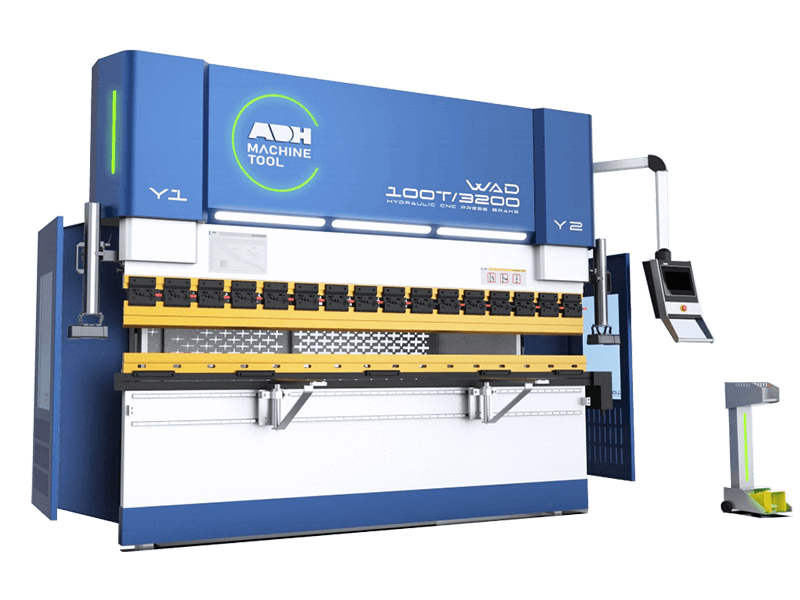
As a manufacturer of sheet metal processing equipment, we offer a variety of machines, including press brakes, fiber laser cutting machines, shearing machines, and ironworkers.

Looking for Machines?

If you're looking for sheet metal fabrication machines, then you've come to the right place!

Our Customers

The following big brands are using our machines.
Contact Us
Not sure which machine is right for your sheet metal product? Let our knowledgeable sales team guide you in selecting the most suitable solution for your needs.
Ask An Expert
Privacy PolicyTerms
Copyright © 2025
linkedin facebook pinterest youtube rss twitter instagram facebook-blank rss-blank linkedin-blank pinterest youtube twitter instagram